National Post UK
Mediterranean Conflict Escalates as Russian Warship Sunk in Libyan Waters

The sinking of a Russian vessel following a suspected Ukrainian drone strike marks a dangerous widening of the conflict.

The National Post

HomeWorld
World

Mediterranean Conflict Escalates as Russian Warship Sunk in Libyan Waters

The sinking of a Russian vessel following a suspected Ukrainian drone strike marks a dangerous widening of the conflict. Military analysts warn that the Mediterranean may no longer be a safe harbour for regional maritime traffic.

DC

David Chen

Foreign Correspondent

Published 23 November 2026·about 5 hours ago 3 min read
Text
Share

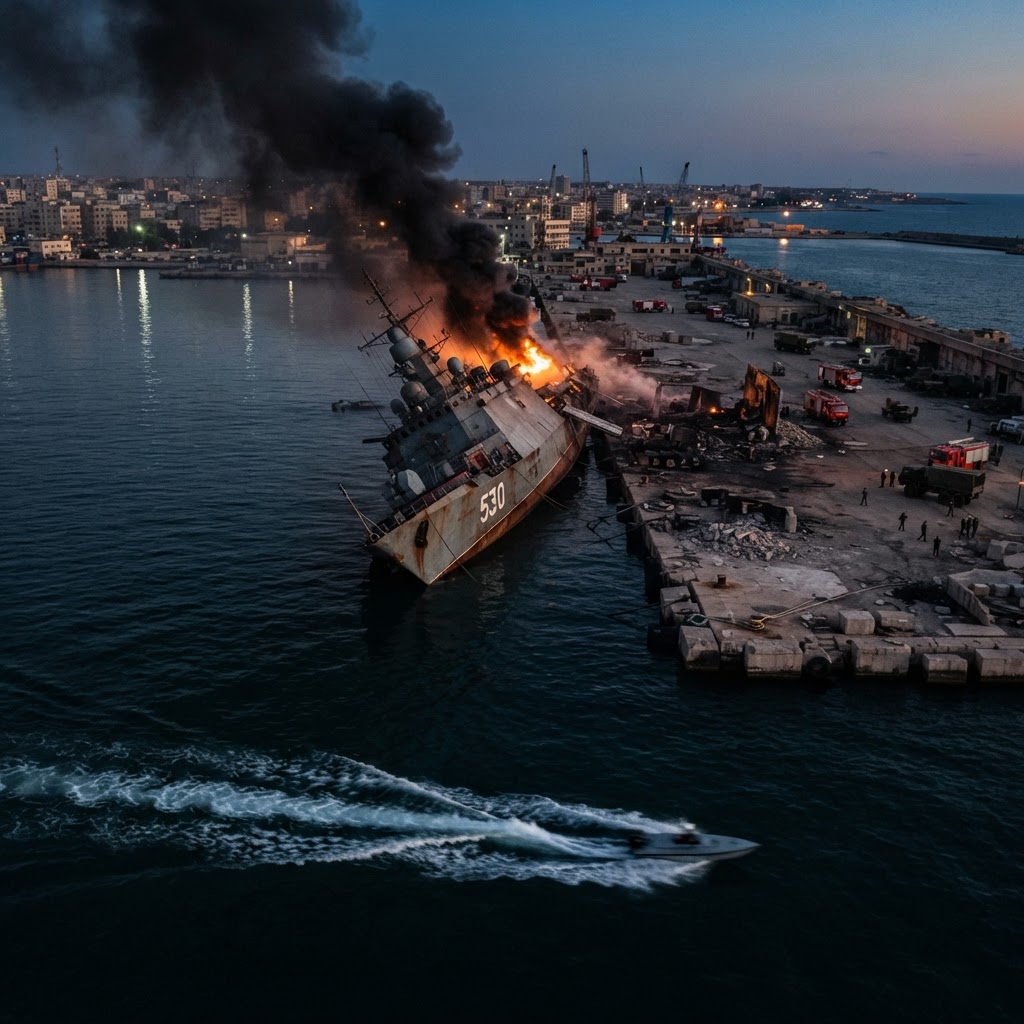
A New Front in the Conflict The conflict between Moscow and Kyiv, which has long been centred on the Black Sea and the eastern reaches of Ukraine, appears to have crossed a critical threshold. On 22 November 2026, a Russian warship was confirmed to have foundered off the Libyan coastline, the victim of a devastating, high-precision sea drone attack. Intelligence sources suggest that the operation bears the hallmarks of Ukrainian maritime special forces, marking an unprecedented expansion of the war into the Mediterranean theatre.

For the past three years, the Mediterranean has functioned as a vital, if uneasy, conduit for international trade and Russian logistical support. That delicate balance was shattered yesterday afternoon when the vessel, reportedly operating in the vicinity of Benghazi, was struck by multiple uncrewed surface vessels (USVs). The resulting explosions triggered a catastrophic failure of the ship's hull, sending it to the seabed in minutes.

Targeting Beyond the Battlefield The danger to global shipping was further underscored by a second, separate strike occurring shortly after the sinking. A Maltese-flagged cargo vessel, transiting through the same waters, was disabled by an incoming drone. While casualty figures remain unconfirmed, the incident has sent a shockwave through the maritime industry, leading to immediate calls for reassessment of security protocols in the region.

Libyan security forces, operating in a complex and often fractured environment, reported the interception of more than 20 additional explosive-laden boats in the immediate vicinity. This suggests that yesterday’s events were not an isolated skirmish, but rather a coordinated attempt to project naval power into a region that had, until now, remained largely insulated from the direct kinetic violence of the Russia-Ukraine war.

The Geopolitical Calculus From the perspective of Whitehall, the escalation is deeply concerning. The Ministry of Defence has long cautioned that the proliferation of low-cost, high-impact drone technology would inevitably allow belligerents to project power well beyond traditional frontlines. Sir Julian Harrington, a senior fellow at the Royal United Services Institute, noted that this development presents a profound challenge to the Royal Navy’s freedom of navigation operations in the Mediterranean.

The move by Kyiv—if confirmed to be a state-sanctioned operation—represents a strategic gamble. By forcing Russia to stretch its defensive capabilities from the Black Sea to the North African coast, Ukraine is compelling Moscow to commit precious resources to a theatre where it cannot rely on its traditional air superiority or secure naval bases.

“This represents a profound shift in the geometry of the conflict, signalling that the Mediterranean is no longer a peripheral theatre in the ongoing war between Moscow and Kyiv.”

Yet, the risks are equally high. The involvement of civilian-flagged vessels, such as the Maltese ship, complicates the legal and diplomatic landscape significantly. Moscow is likely to view these attacks as a direct provocation, potentially leading to increased Russian naval patrols and a higher risk of accidental encounters with NATO vessels operating in the region.
An Uncertain Future As international investigators and intelligence agencies scramble to piece together the events of 22 November, the wider world must contend with the reality that the war is no longer contained within the borders of Eastern Europe. The Mediterranean, historically the cradle of Western trade and communication, has become a high-stakes chessboard for the latest iteration of naval warfare. For now, the focus remains on the salvage operations off Benghazi, but the geopolitical aftershocks will undoubtedly be felt in London, Brussels, and Moscow for months to come.

TopicsRussia-Ukraine WarMediterraneanLibyaNaval WarfareGeopoliticsMaritime Security
Share

About the Author

DC

David Chen

Foreign Correspondent

David Chen reports for National Post UK with a focus on rigorous analysis and authoritative journalism — a trusted voice across British public life.

Reader Discussion · 8

Subscribers can join the conversation.

SUBSCRIBE TO COMMENT →
M
Margaret Hughes23 Nov

It is absolutely heartbreaking to see more lives lost at sea. Regardless of the politics involved, we should be prioritizing de-escalation over military posturing before this turns into a much larger disaster.

D
David Thorne23 Nov

Having spent years working in maritime security, I can say that the waters around Libya have become a powder keg. This incident is just a symptom of a much wider geopolitical struggle that shows no signs of cooling down.

M
Margaret Hughes23 Nov

I find it hard to believe the official reports coming out of the region right now. We are being told so little about the circumstances of the sinking that it is impossible to tell if this is a genuine accident or a calculated strike by another state actor.

D
David Thorne23 Nov

It seems fairly obvious that Russia has been overextending its reach in North Africa for some time now. If their presence there is being challenged, it is only a matter of time before the reality of their stretched resources catches up with them.

S
Sarah Jenkins23 Nov

I find it hard to believe the official reports coming out of the region right now. It feels like we are being fed a very specific narrative before all the facts are actually known.

S
Sarah Jenkins23 Nov

Having spent time working in Tripoli, I am deeply concerned for the local population who are once again caught in the middle of a conflict that isn't their own. It is a frightening turn of events for a region already struggling with stability.

A
Arthur Penhaligon23 Nov

This is a significant escalation that was entirely predictable given the level of Russian interference in North Africa. We really need to know what our own government is doing to ensure this conflict doesn't spill over into our trade routes.

A
Arthur Penhaligon23 Nov

This is a dangerous escalation that risks drawing in further international powers. We really ought to be focusing our diplomatic efforts on de-escalation rather than watching this spread across the Mediterranean.

More from World

Most Read in World

Morning Briefing

The day's top stories, before 7am

Join 40,000 readers who start their morning with National Post UK.