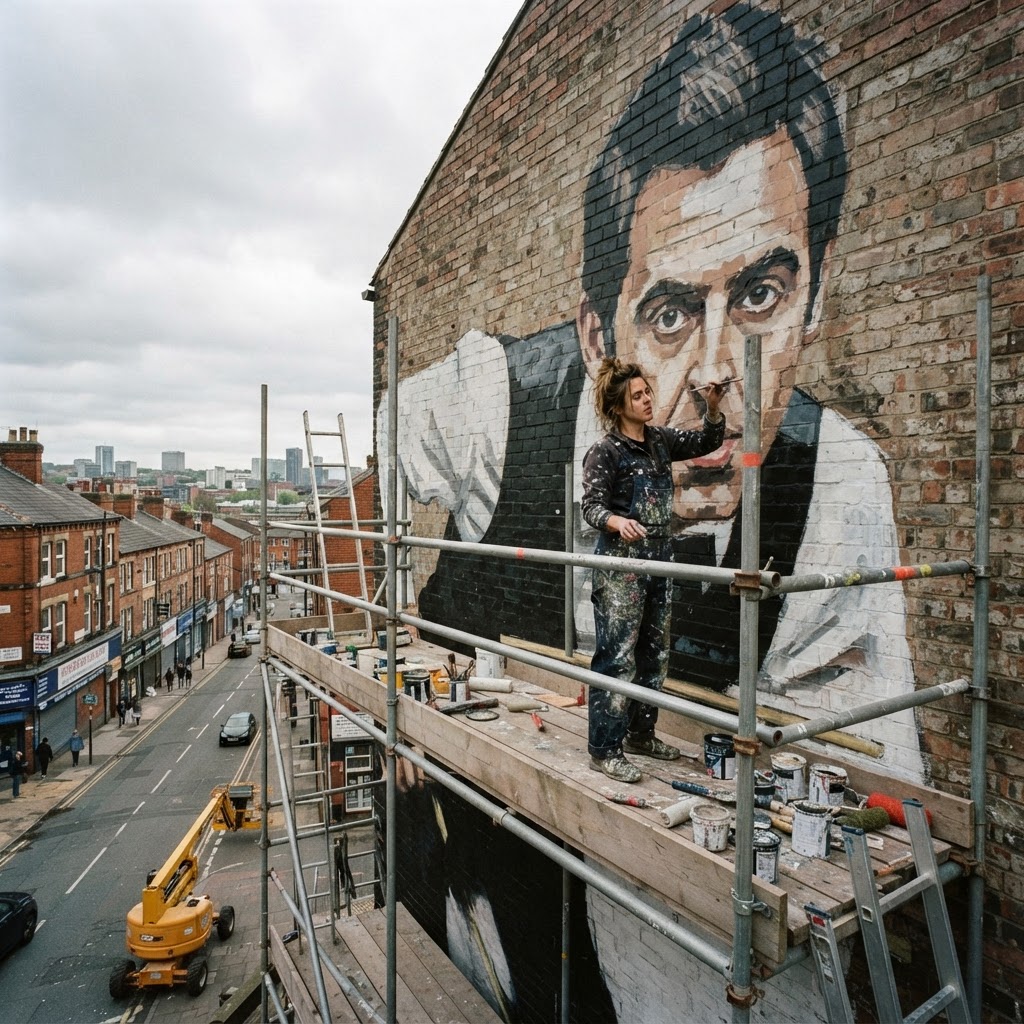
As a new mural of seven-time world champion Ronnie O’Sullivan stirs debate in the spiritual home of snooker, the creator has broken their silence. The artist maintains that the work, which has become a lightning rod for local critique, is far from its intended final form.
A Crucible of Controversy
In the grey, industrious sprawl of Sheffield, few things hold as much civic gravity as the sport of snooker. As the city prepares for its annual migration of spectators to the Crucible Theatre, a new artistic addition to the local landscape has provoked an unexpected intensity of public scrutiny. A sprawling mural depicting the seven-time world champion Ronnie O’Sullivan, rendered with ambitious scale, has become the subject of fervent debate amongst residents and arts commentators alike. What began as a tribute to the undisputed icon of the sport has morphed into a litmus test for urban aesthetics in a city that prides itself on its authentic cultural identity.
The Artist’s Plea for Patience
The controversy reached a crescendo within the last 24 hours as social media discourse turned increasingly critical, with detractors questioning the stylistic choices and likeness of the piece. In response, the artist behind the project has issued a measured, formal defense. Addressing the mounting pressure, they clarified that the work is currently in a state of flux—a transitionary phase in a multi-stage creative process. The artist insists that the criticism, whilst passionate, is premature, noting that the mural remains significantly unfinished and that key details, which are set to provide the necessary nuance and depth to O’Sullivan’s portrait, are yet to be applied.
Sheffield’s Snooker Soul
To understand the depth of the reaction, one must recognise the unique relationship Sheffield shares with professional snooker. Since the World Championship found its permanent home at the Crucible in 1977, the city has become synonymous with the green baize. It is not merely a host city; it is a pilgrimage site for millions of fans. Murals and public art in Sheffield often carry a heavy burden of representation, expected to reflect the grit and tradition of the Steel City whilst celebrating its global cultural reach. Any depiction of a figure as monumental as O’Sullivan is bound to be subjected to microscopic inspection by a public that feels a profound sense of ownership over the sport’s heritage.
Contextualising the Modern Portrait
Art historians suggest that public portraiture often encounters this exact friction. When an artist takes on a living legend, they are not only competing with the physical likeness but also with the collective memory and myth-making surrounding the individual. O’Sullivan, known for his mercurial brilliance and complex persona, presents a particularly challenging subject. To paint him is to attempt to capture the ‘Rocket’ at rest—a task that requires a delicate balance between realism and symbolic intent. The current discourse highlights a wider tension in British urban design, where the appetite for street art is high, but the tolerance for works that do not immediately align with traditional sensibilities remains narrow.
Looking Ahead
As the scaffolding remains in place and the artist prepares for the final stage of work, the city finds itself in a state of cautious anticipation. Whether the completed mural will silence the critics or cement itself as a divisive fixture of the landscape remains to be seen. However, for those who value the intersection of sporting history and public art, the piece serves as a reminder that the creative process is rarely linear. In Sheffield, the wait for the final flourish continues, underscored by the hope that when the final paint is dry, the tribute will finally mirror the stature of the man it seeks to honour.