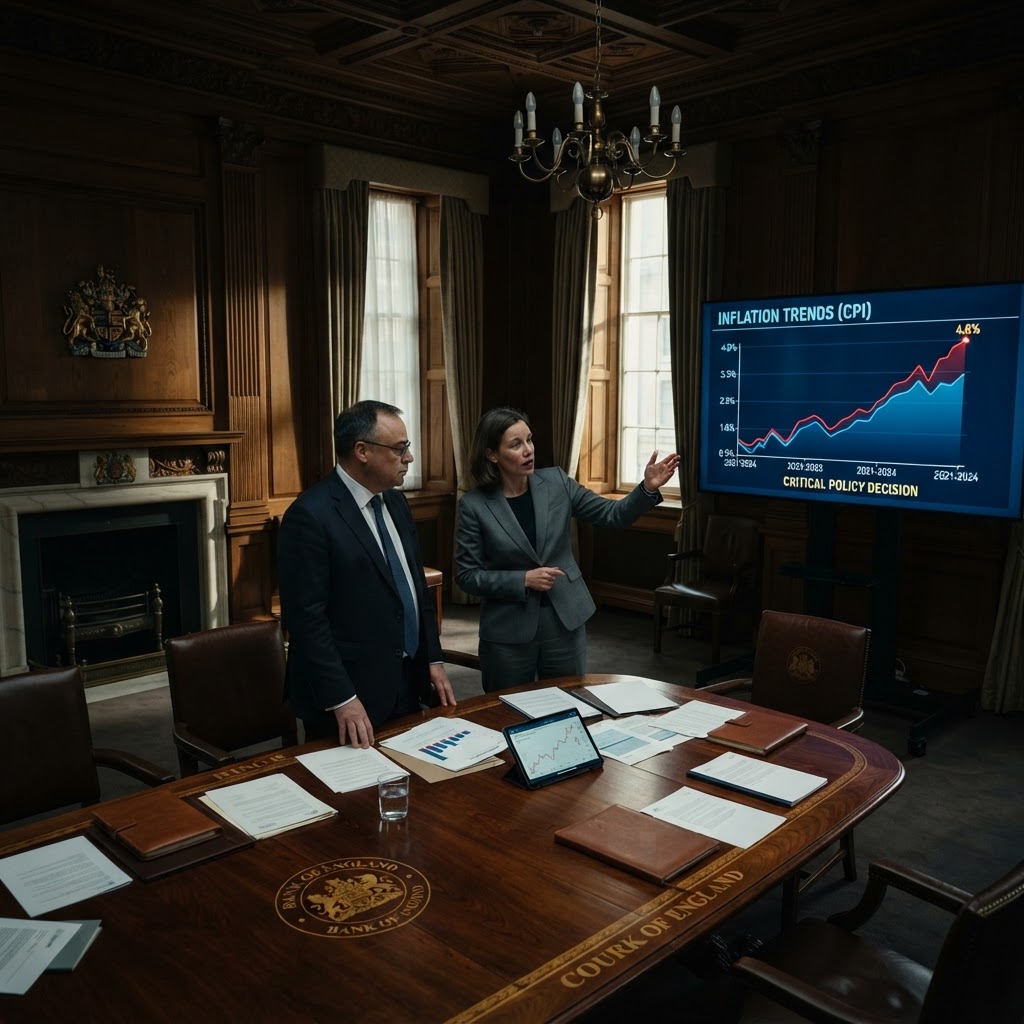
The Bank of England’s Deputy Governor has laid the groundwork for potential future tightening, citing persistent inflationary risks. As the headline rate sits stubbornly above target, the Monetary Policy Committee faces a delicate balancing act.
The specter of further tightening
In a signal that has sent ripples through the City of London, Deputy Governor Dave Ramsden has explicitly stated that he is prepared to advocate for an increase in interest rates should the current upside pressures on inflation remain unabated. His remarks, delivered in the wake of the Monetary Policy Committee’s decision on 17 September to maintain the base rate at 3.75 percent, suggest that the central bank’s recent pause may be short-lived rather than the start of a sustained period of stability.
The inflation disconnect
The core of the concern lies in the disconnect between current policy and the consumer reality. With the UK inflation rate standing at 3.1 percent, the Bank of England finds itself tasked with wrestling figures down toward its mandated two percent target. While the MPC has opted for patience to observe the lag effects of previous rate adjustments, Mr Ramsden’s intervention serves as a firm reminder that the central bank remains committed to its primary objective of price stability, even at the cost of broader economic cooling.
Energy costs and geopolitical headwinds
A primary driver of this stubborn inflationary environment remains the volatile energy market. Geopolitical tensions, particularly in regions critical to the global energy supply chain, continue to exert upward pressure on utility bills and industrial input costs. Analysts note that these external shocks are proving difficult to insulate against, creating a secondary round of domestic price rises that have begun to seep into wage settlements and services inflation. The MPC remains particularly wary of this entrenchment, fearing that if inflationary expectations become unanchored, restoring stability will require a significantly more painful and aggressive interest rate path.
Expert analysis and market sentiment
Financial analysts at major institutions have responded with caution, interpreting the Deputy Governor’s comments as an attempt to manage market expectations ahead of the next committee meeting. By explicitly mentioning his willingness to vote for hikes, Mr Ramsden is effectively placing a floor under market interest rate expectations. Investors now face a period of heightened sensitivity to incoming data, particularly regarding the labour market and retail expenditure, both of which are seen as critical indicators of whether the economy can withstand further tightening without falling into a technical recession.
The road ahead for the MPC
The challenge for the Bank of England is twofold. On one side, it must ensure that the cost of borrowing is high enough to curb excess demand and dampen inflationary pressures. On the other, it must avoid the danger of overtightening in an environment where business investment remains fragile. Mr Ramsden’s stance indicates that, for a growing faction within the committee, the risk of doing too little to combat inflation now outweighs the risk of policy overreach. As the autumn progresses, the central bank’s narrative will likely shift toward whether the current 3.75 percent setting provides sufficient restriction to bring inflation back to its target by the end of next year. For now, the prospect of higher interest rates has moved from a remote possibility to a clear and present threat to those reliant on credit, setting the stage for a high-stakes policy debate in the coming months.