
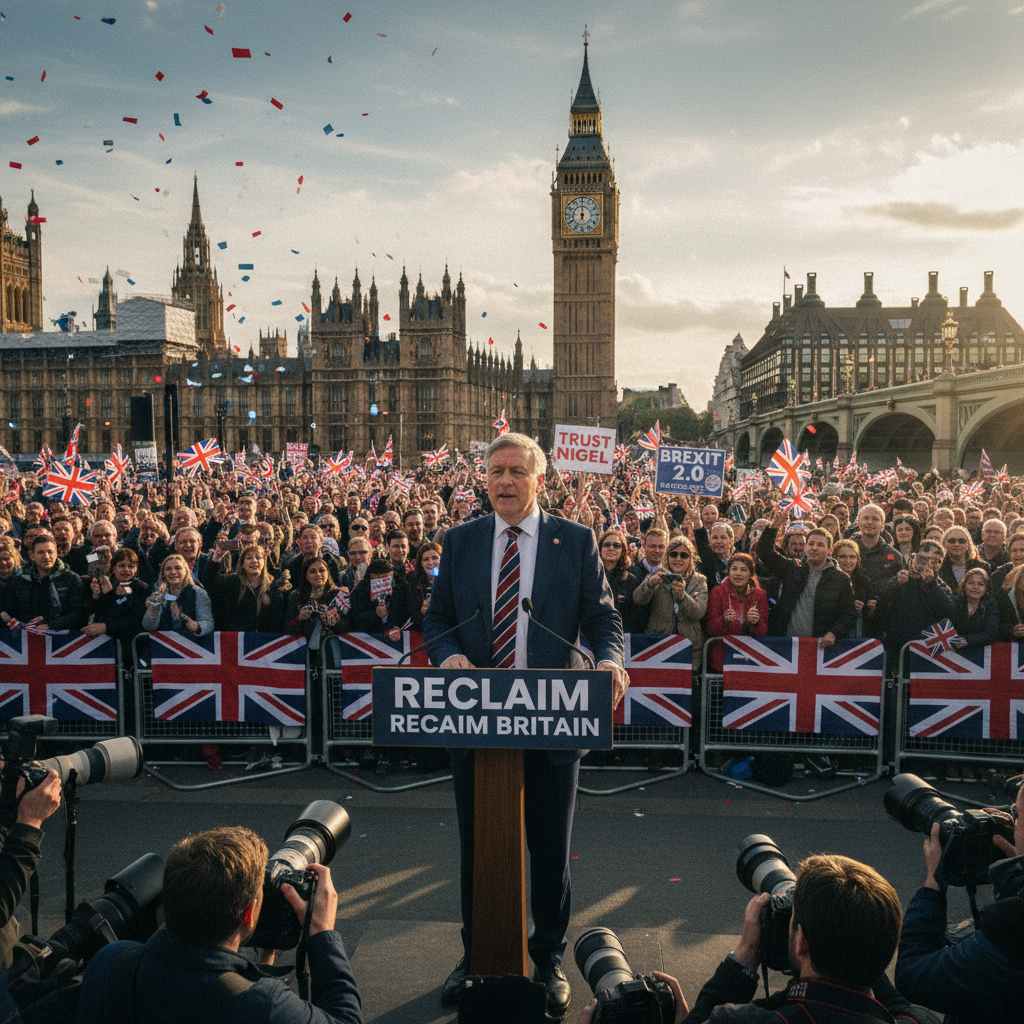
In a decisive move that has sent ripples through the UK political landscape, Nigel Farage has announced his return to frontline politics by replacing Richard Tice as leader of Reform UK. Asserting his bid for the Clacton constituency, a seat once held by his original party UKIP, Farage’s return embodies a formidable challenge not just to Labour’s growing dominance but to the Conservative Party’s electoral viability.
Farage’s confirmation of his candidacy comes less than a week after he stated he would abstain from running, citing a desire to support Donald Trump’s campaign in the United States. His shift in focus to British politics has sparked speculation about his motives and the potential consequences for the Conservative Party, which is already grappling with internal divisions and waning public support.
A Political Rebellion
Farage has framed his return as a "political revolt," vowing to ignite a grassroots movement against what he perceives as a Labour landslide in the upcoming elections. Speaking at a press conference in London, he claimed, "The time is now for a new vision and a new voice for the people of Clacton and beyond. This is not just about one constituency; it’s a fight for the future of our nation." This proclamation underlines a clear intent to galvanise voters disillusioned by traditional parties.
“"This is not just about one constituency; it’s a fight for the future of our nation."”
The Clacton constituency, which Farage seeks to represent, gained notoriety during the 2014 by-election when UKIP secured a historic win, marking the first time a National Health Service and a UKIP candidate had achieved such success. With Farage at the helm of Reform UK, the party is hoping to reclaim this stronghold and build momentum across the country.
Concerns from the Conservatives
The resurgence of Farage has raised immediate alarms within the Conservative Party, with senior figures predicting the potential for "vote splitting" among right-wing voters. The fragmentation of the right could unfurl disastrous consequences for incumbent Conservative MPs, particularly in marginal constituencies where every vote counts.
A prominent Conservative strategist, who spoke on the condition of anonymity, voiced concern over the division that Farage's candidacy could create. "The last thing we need is for the right votes to be siphoned off by Reform UK, especially when Labour is likely set to make significant strides in key areas," they warned. This sentiment seems to be echoed across party lines, with many Conservatives fearing that Farage’s platform could diminish their chances in the fast-approaching election.
Public Reaction and Political Landscape
Public reception of Farage’s announcement has also been mixed. While some voters in Clacton express excitement about a familiar face returning to political life, others remain sceptical. "He has his work cut out for him; it’s one thing to rally support, another to win consistently in a constituency that feels neglected by the main parties," remarked local resident Elizabeth Donovan.
Experts suggest that while Farage retains a loyal base, his ability to expand that base and resonate with undecided voters will be crucial. Commentator and former MP Sarah Wollaston noted, "Farage is adept at capturing anger and discontent, but he needs to present a positive vision rather than merely critiquing Labour and the Conservatives. Voters will want to see what he can offer beyond his familiar rhetoric."
A Broader Implication for the UK Political Scene
The implications of Farage's return extend beyond Clacton and the immediate June elections. This resurgence signals a potential resurgence of the populist movement that has pervaded various Western democracies post-Brexit. Political analysts are observing closely how Farage’s position will affect not only Reform UK’s fortunes but also the broader UKIP-following factions that may feel emboldened by his leadership.
As the election campaigns begin to heat up, the dynamics surrounding Farage’s candidacy may alter the strategies of major parties. The prospect of aligning with or distancing from Farage will create difficult dilemmas for politicians as they navigate their electoral paths. The potential for a fractious and fragmented election looms large, as Farage re-enters the political stage, intensifying competition among right-wing parties and shifting the battleground entirely.
Farage's return to politics may also rekindle debates around populism and national identity, which have defined British politics in the last decade. While he has been a polarising figure, his capacity to mobilise support among disenchanted voters remains prominent, and his narrative of challenging the political elite is likely to resonate in the current climate.