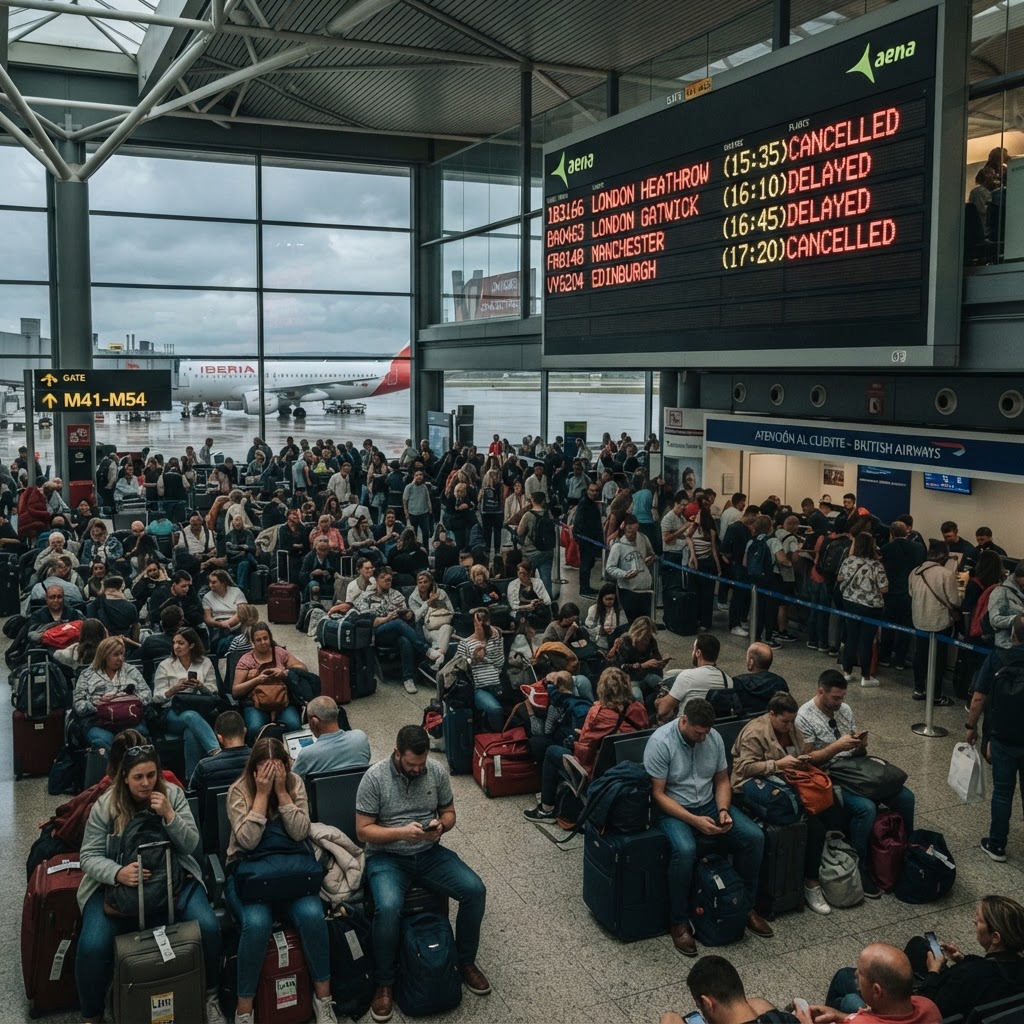
The Anatomy of the Shutdown Spain is bracing for a day of unprecedented disruption as a general strike, scheduled for November 11, 2026, promises to bring the country to a near-standstill. The coordinated industrial action, which spans across critical transport hubs, public services, and the hospitality sector, has sent shockwaves through the travel industry. For the thousands of British tourists currently in Spain or planning to transit through the country’s airports, the reality is one of profound uncertainty.
Air Travel Under Pressure The aviation sector is expected to bear the brunt of the protests, with preliminary figures already painting a bleak picture. Reports reaching London indicate that Barcelona’s El Prat airport faces a staggering 56 per cent cancellation rate, with other major gateways such as Madrid-Barajas and Palma de Mallorca expected to suffer similar operational paralysis. The impact is not limited to the mainland; the Canary Islands, a perennial favourite for British winter sun-seekers, are also braced for severe logistical challenges as ground staff and air traffic control services manage reduced capacity.
A spokesperson for the Foreign, Commonwealth and Development Office has urged British nationals to remain vigilant. The situation is fluid, and passengers are advised to contact their airlines immediately, as many carriers are already pre-emptively grounding flights to avoid the potential for overnight strandings.
Beyond the Terminal The industrial action extends well beyond the tarmac, affecting the very fabric of daily life in major Spanish cities. Walkouts by public transport workers mean that metropolitan buses, metros, and train services will be operating on skeleton schedules, if at all. For those who manage to land at their destination, the prospect of travelling to their accommodation or onward to resorts remains a significant hurdle. Furthermore, the disruption encompasses shops, museums, and restaurants, suggesting that the typical holiday experience will be heavily constrained throughout the duration of the strike.
Expert Perspective on Labour Relations This industrial unrest is symptomatic of broader, simmering tensions within the Spanish labour market. Analysts suggest that the scale of the November 11 action is a response to long-standing grievances regarding wage stagnation and working conditions in the service economy. For the UK traveller, these macro-economic shifts manifest as a disruption that transcends the standard inconvenience of a delayed flight. It is a reminder that the tourism infrastructure upon which millions of Britons rely is susceptible to the complexities of local civil discourse.
Dr. Elena Rossi, an independent travel logistics consultant, noted that this is a critical test for Spanish civil contingency planning. 'The sheer breadth of this strike, incorporating both private service sectors and public utility providers, creates a cascading effect. When ground handling services align with local transport unions, the connectivity of the entire country becomes compromised,' she observed.
Advice for the Affected Travellers are encouraged to monitor their airline apps and the official social media channels of their transport providers. Under the UK-EU trade and cooperation agreement, while passengers retain certain rights regarding flight cancellations, the extraordinary nature of a nationwide strike may complicate claims for additional compensation. The primary focus for the next 24 hours should be on ensuring safe transit to secure accommodation rather than relying on scheduled onward travel itineraries.
As the sun sets over the Mediterranean, the anticipation of tomorrow’s shutdown remains the dominant narrative. For those scheduled to be in the air or on the move, patience is the only reliable asset, as the logistical machinery of one of Europe’s most popular holiday destinations comes to a temporary, yet total, halt.
“The sheer breadth of this strike, incorporating both private service sectors and public utility providers, creates a cascading effect.”