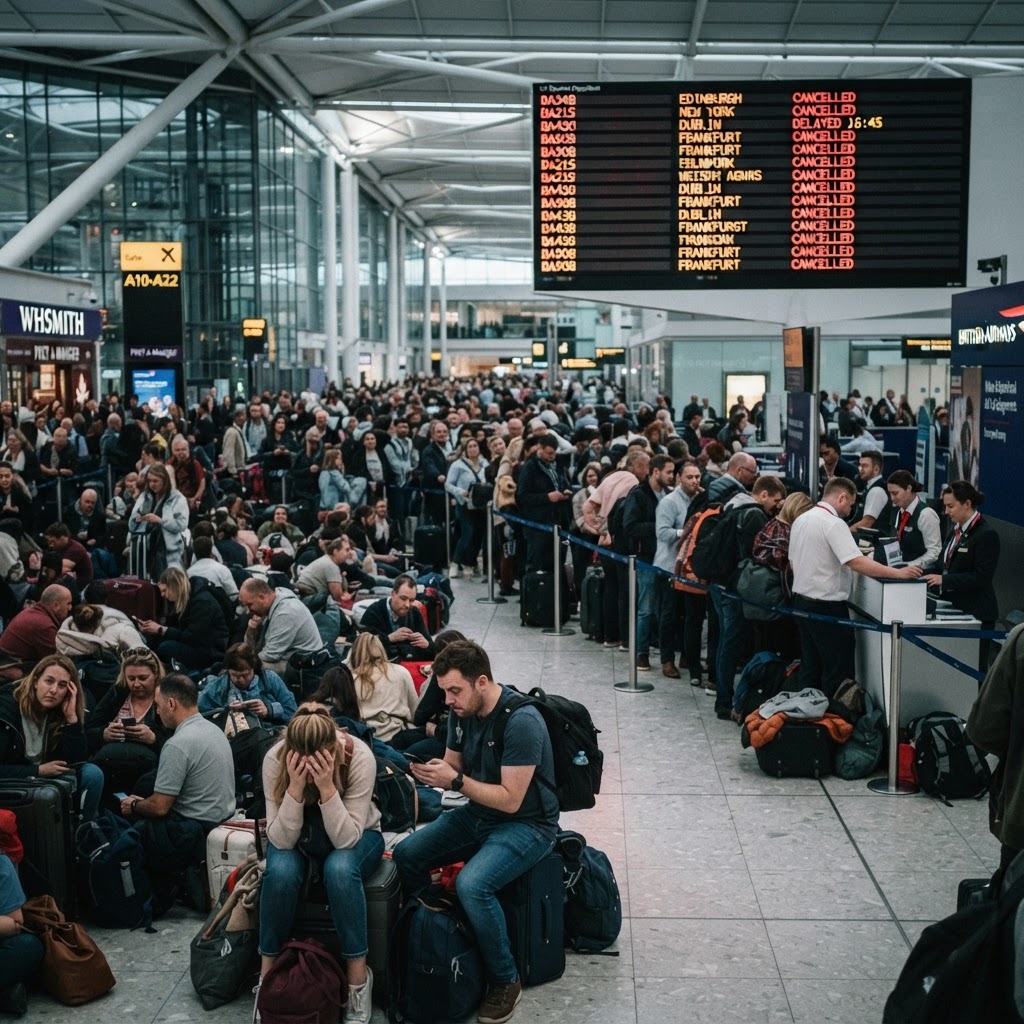
Tens of thousands of passengers remain grounded as Nats struggles to rectify a catastrophic failure in flight processing architecture. The disruption, which began on Tuesday, has now extended into a second day of widespread operational paralysis.
The Anatomy of an Operational Collapse
The British aviation sector has been plunged into a state of acute uncertainty following a persistent technical failure within the National Air Traffic Services (Nats) flight processing system. The outage, which first manifested on Tuesday, 8 September 2026, has effectively paralysed the nation’s primary departure infrastructure. Despite assurances that the core airspace remains open, the mechanisms responsible for the intricate task of automated flight plan validation and coordination have suffered a near-total collapse. This has necessitated a shift to manual intervention, a transition that has bottlenecked movement across the country.
Regional Hubs Bear the Brunt
Airports across the United Kingdom, from Bristol to Manchester, have reported significant flight cancellations and indefinite delays. The ripple effect of the system’s instability has been profound, with thousands of travellers left stranded in departure lounges. Industry analysts have noted that the complexity of modern flight paths makes the shift to manual air traffic control an incredibly slow and arduous process, leading to a cascading failure of scheduled services. While Nats engineers have been working around the clock to restore the primary systems, the recovery phase is expected to be protracted as controllers struggle to clear the backlog of displaced aircraft.
The Fragility of Modern Connectivity
This incident has reignited debates concerning the resilience of critical national infrastructure. Aviation experts suggest that the current reliance on legacy processing systems, even when supplemented by modern software, creates a single point of failure that the industry can ill afford. Former transport consultants have pointed out that while the UK’s airspace is among the busiest in the world, the underlying digital architecture must be subjected to rigorous modernisation if it is to withstand the demands of the post-pandemic era. The inconvenience caused to passengers today underscores the stark reality that, despite the sophistication of aviation technology, the entire network remains beholden to the integrity of its central processing nodes.
Advice to Passengers
As the disruption carries into Wednesday, the official guidance remains clear: passengers should not proceed to their airports without first verifying their flight status with their respective airline. The Civil Aviation Authority has issued reminders regarding consumer rights in the event of major delays, though airlines are likely to cite 'extraordinary circumstances' to mitigate compensation claims. The focus remains on stabilising the network before normal operations can resume, but as the backlog grows, the prospect of a swift return to schedule appears increasingly optimistic.