National Post UK
The Padel Dilemma: How Britain’s Fastest-Growing Sport is Colliding with Local Planning

As padel courts proliferate across the British landscape, the rapid expansion is triggering a new wave of local governme

The National Post

HomeSport
Sport

The Padel Dilemma: How Britain’s Fastest-Growing Sport is Colliding with Local Planning

As padel courts proliferate across the British landscape, the rapid expansion is triggering a new wave of local government disputes. While enthusiasts hail the sport as the natural heir to tennis, residents are raising concerns over noise, light pollution, and the encroachment of private leisure facilities on public spaces.

TB

Tom Bradley

Sports Correspondent

Published 19 October 2026·1 day ago 3 min read
Text
Share

A Sporting Phenomenon In the quiet corners of suburban sports clubs and the redeveloped fringes of industrial estates, a familiar sound is echoing across the British Isles. It is not the sharp, singular crack of a tennis ball against a carbon-fibre frame, but a deeper, more rhythmic volley that signals the arrival of padel. The sport, which originated in Mexico and found its spiritual home in Spain, has become the defining leisure narrative of 2026. With participation figures soaring, padel has transitioned from an exotic continental pastime to a staple of the British athletic diet.

The Cultural Fit The affinity for padel within the United Kingdom is hardly surprising to those who understand the country’s deep-seated racquet-sport heritage. Britain has long held an institutional love affair with tennis, squash, and badminton. Padel, often described as a hybrid of these disciplines, offers a lower barrier to entry for the amateur, requiring less technical prowess than tennis while maintaining the tactical intensity of squash. Sports sociologists note that the game’s social architecture—it is played exclusively in doubles—taps into the British desire for communal, club-based exercise. As facilities emerge from Surrey to the Scottish Highlands, the sport is being heralded as the antidote to the stagnation of traditional club memberships.

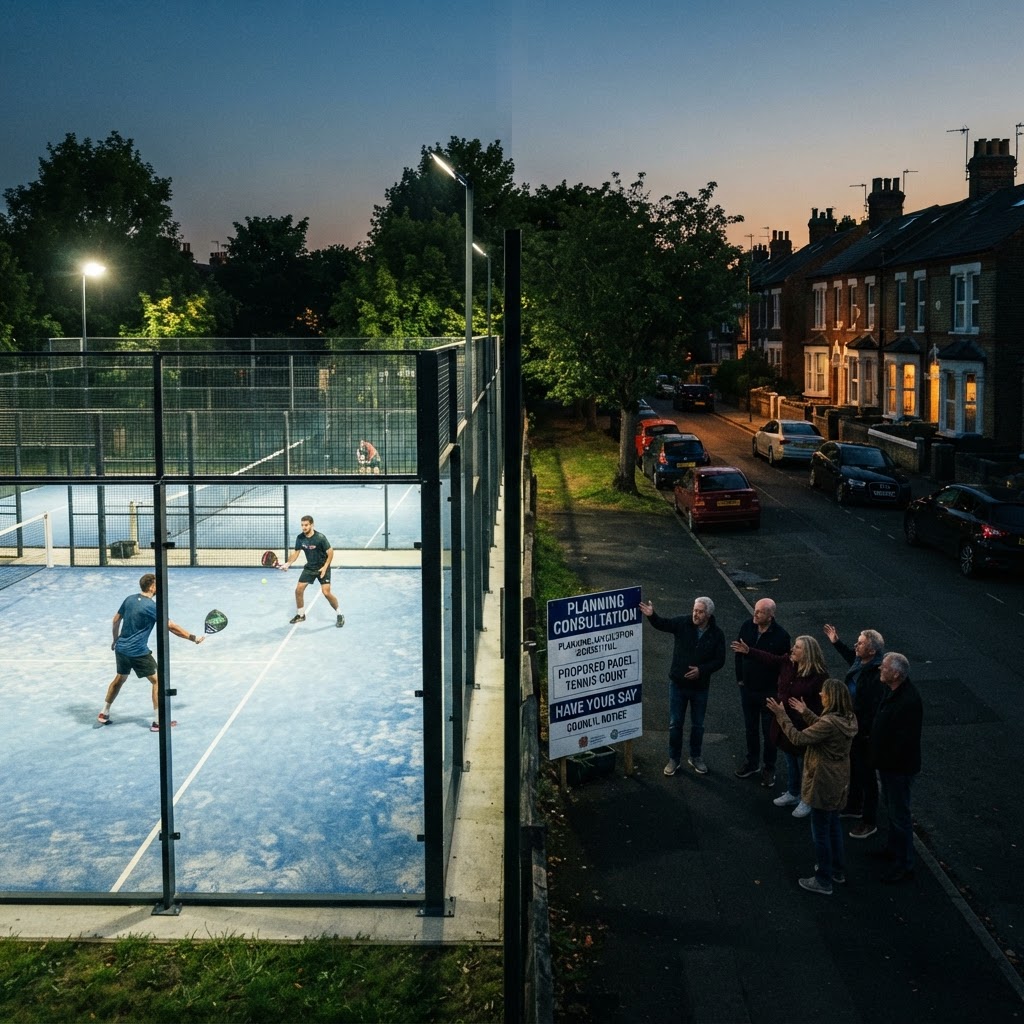
The Planning Paradox Yet, the physical manifestation of this enthusiasm is meeting stiff resistance. The rapid expansion of padel infrastructure requires the construction of caged, illuminated courts, often in locations that have historically been dormant or under-utilised. This has created a direct conflict between the ambitions of private court operators and the sensitivities of local planning authorities. In leafy neighbourhoods where quietude is the primary aesthetic, the arrival of floodlit evening sessions has prompted an outpouring of formal grievances. Local councils are increasingly caught in the middle, forced to balance the public health benefits of rising physical activity levels against the legitimate concerns of residents regarding noise pollution and the loss of green space.

The Debate Escalates Planning applications for padel centres in several London boroughs have been stalled, with opponents citing the intrusive nature of the high-fenced structures. These appeals often hinge on the environmental impact of the necessary lighting arrays and the acoustic resonance of the ball striking the court’s toughened glass walls. While supporters argue that such developments are merely a modern evolution of leisure infrastructure, critics maintain that the industrial nature of these sites is incompatible with the character of residential districts. As local authorities struggle to draft unified guidelines for this new asset class, the uncertainty is beginning to chill investment in some regions.

Looking Ahead The industry remains bullish, despite the regulatory headwinds. Investors argue that the long-term viability of British sport depends on adapting to changing demographics and preferences. They suggest that with better acoustic design and more sympathetic architectural integration, the friction will dissipate. Nevertheless, the current tension serves as a poignant reminder that in Britain, every new development—no matter how athletic in purpose—must negotiate the complex, historically protected fabric of the local community.

TopicsPadelSportPlanningUK InfrastructureLifestyleTennis
Share

About the Author

TB

Tom Bradley

Sports Correspondent

Tom Bradley reports for National Post UK with a focus on rigorous analysis and authoritative journalism — a trusted voice across British public life.

Reader Discussion · 5

Subscribers can join the conversation.

SUBSCRIBE TO COMMENT →
J
James Halloway19 Oct

The demand is undeniably there, but it is clear that developers are cutting corners to get these courts open as quickly as possible. We need national guidance on planning, otherwise we will just end up with thousands of disgruntled neighbours.

E
Eleanor Rigby19 Oct

Perhaps we should be looking at converting some of the redundant retail space in our town centres instead of fighting over green belt land. It would kill two birds with one stone, revitalising the high street and giving us a place to play.

M
Malcolm Fletcher19 Oct

As someone who has lived next to a sports club for thirty years, I can confirm that the constant thudding is significantly louder than a standard tennis match. It is not just about progress, it is about maintaining the quality of life for those of us already here.

S
Sarah Jenkins19 Oct

I have been playing at my local club for six months and it is the most inclusive game I have ever picked up. It is a shame that planning bureaucracy might stifle what is clearly a much-needed boost to community health.

D
David Thorne19 Oct

It is great to see a new sport gaining traction, but our local council seems completely unprepared for the noise complaints. They really need to mandate better acoustic screening before approving any more courts near residential zones.


More from Sport

Most Read in Sport

Morning Briefing

The day's top stories, before 7am

Join 40,000 readers who start their morning with National Post UK.