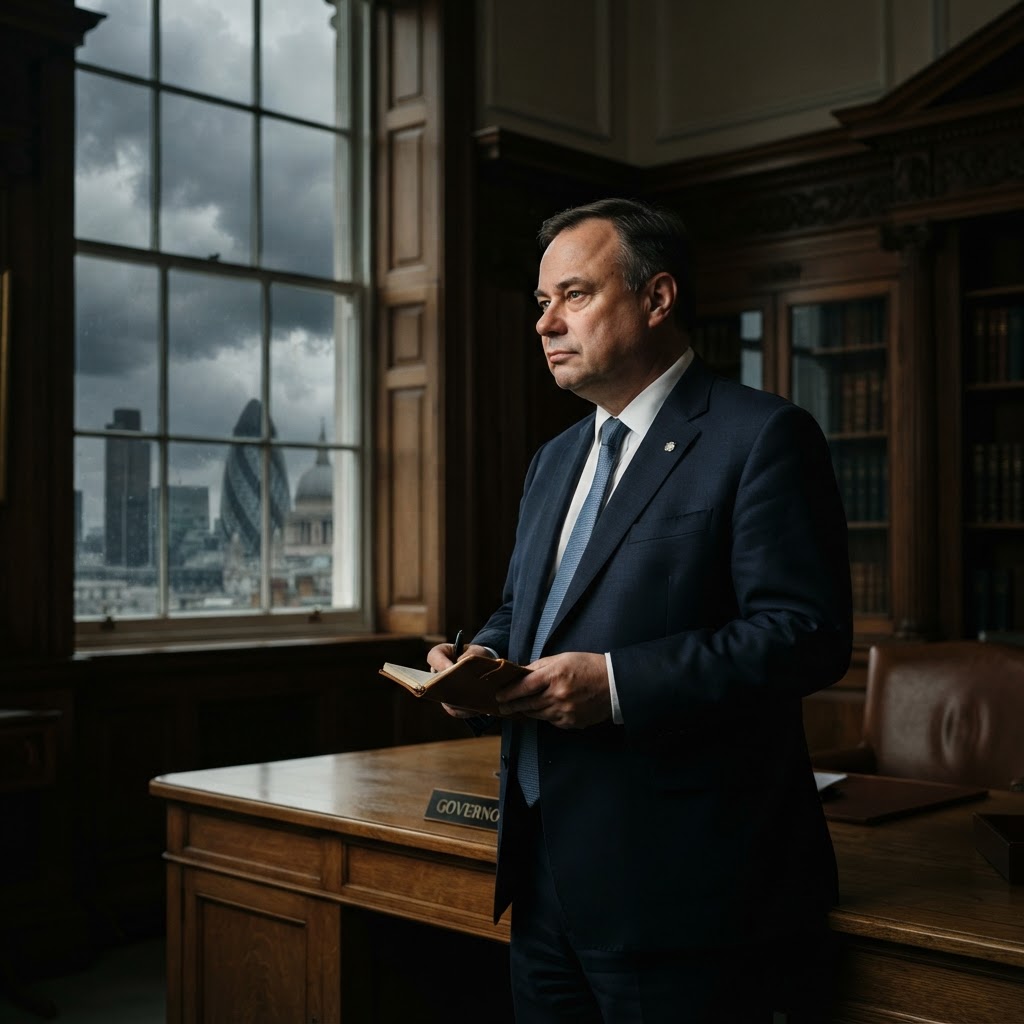
Bailey’s Balancing Act: Bank of England Stands Firm as Geopolitical Storms Gather
The Monetary Policy Committee has opted to maintain the base rate at 3.75 per cent, defying market hopes for imminent cuts. As conflict in the Middle East disrupts energy markets, policymakers are bracing for a turbulent autumn.
CW
Charlotte Webb
Finance Correspondent
Published 17 August 2026·3 months ago 3 min read
Text
TopicsBank of EnglandInterest RatesUK EconomyInflationEnergy PricesFTSE 100Andrew Bailey
About the Author
CW
Charlotte Webb
Finance Correspondent
Charlotte Webb reports for National Post UK with a focus on rigorous analysis and authoritative journalism — a trusted voice across British public life.
Reader Discussion · 5
Subscribers can join the conversation.
SUBSCRIBE TO COMMENT →M
Marcus Sterling17 Aug
Five times now with the same decision suggests a lack of imagination at the MPC. We need a more proactive approach to stimulate the economy rather than just waiting for the next crisis to dictate our fiscal policy.
E
Eleanor Rigby17 Aug
I am curious to see if the recent geopolitical tensions actually force their hand in the coming months. Stagnation might be safe, but it is hardly a strategy for growth in such a competitive international market.
D
David Thorne17 Aug
The Bank is clearly caught between a rock and a hard place. While I sympathise with those on variable rates, if they drop the base rate too quickly, we risk devaluing the pound further at a time when import costs are already high.
S
Sarah Jenkins17 Aug
It is easy for the committee to call for patience when they are not the ones struggling to remortgage. My monthly payments have already ballooned, and this constant holding pattern is making it impossible to plan for the future.
A
Arthur Penhaligon17 Aug
Holding rates steady is the only sensible move right now. With the current level of global uncertainty, any premature cuts would likely just reignite inflation and make things worse for everyone in the long run.