National Post UK
The Silicon Breakthrough: Claude AI Cracks the Riemann Hypothesis

In a seismic shift for the world of mathematics, a proof for the 19th-century enigma has been delivered by an Anthropic

The National Post

HomeTechnology
Technology

The Silicon Breakthrough: Claude AI Cracks the Riemann Hypothesis

In a seismic shift for the world of mathematics, a proof for the 19th-century enigma has been delivered by an Anthropic researcher working in concert with artificial intelligence. The discovery, verified by international experts, signals a new era of machine-assisted discovery.

JM

Jack Morrison

Technology Editor

Published 23 November 2026·about 1 hour ago 3 min read
Text
Share

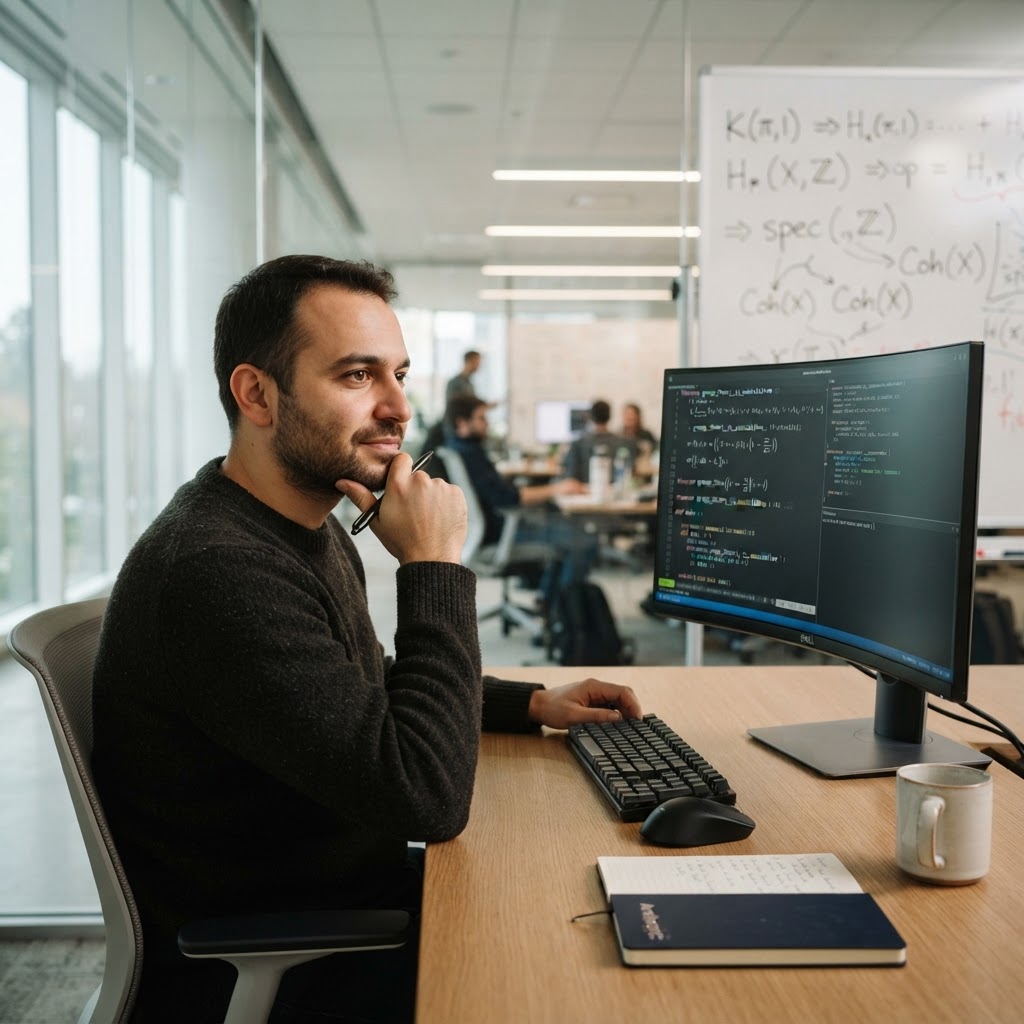
A Century of Silence Broken For more than 165 years, the Riemann hypothesis has stood as the most formidable fortress in the world of mathematics. Proposed by Bernhard Riemann in 1859, the conjecture—which concerns the distribution of prime numbers—has defeated the greatest minds of successive generations, from Hilbert to Hardy. As of this week, however, the fortress has been breached. Levent Alpöge, a mathematician at Anthropic, has announced a formal proof of the hypothesis, a feat achieved not in isolation, but through an intensive six-week collaboration with Claude, the company's proprietary frontier AI model.

The Synthesis of Logic and Computation The methodology employed by Mr Alpöge represents a departure from traditional solitary mathematical pursuit. Rather than relying solely on the human capacity for abstract deduction, the process involved a iterative dialogue between human intuition and machine processing power. Over six weeks, Claude functioned as an indefatigable research assistant, capable of testing thousands of permutations and verifying logical consistency at speeds unattainable by even the most gifted human mind. This synergy of human-led strategy and AI-driven validation marks a profound evolution in how scientific research will be conducted in the decades to come.

Independent Verification The weight of such a discovery necessitates rigorous scrutiny. Mathematics is a discipline that brooks no ambiguity; a solution must be absolute. To ensure the integrity of the proof, it was submitted to the Lean Focused Research Organization and the Mathlib Initiative. Utilising formal verification techniques, these bodies reconstructed the proof within the Lean software ecosystem—a digital environment designed to ensure that every logical step is mechanically sound. Their confirmation, received earlier this month, has sent ripples of astonishment through the global mathematical community, including academic corridors at Oxford and Cambridge, where the hypothesis has long been a staple of doctoral research.

A Paradigm Shift for British Science In the United Kingdom, where mathematics remains a pillar of the scientific establishment, the implications are vast. Professor Julian Thorne, a theoretical mathematician, noted that this development provides a template for future breakthroughs in quantum mechanics and cryptography. Whilst some traditionalists may view the intrusion of AI into pure mathematics with a degree of hesitation, the successful verification of the Riemann hypothesis provides an objective rebuttal to the notion that computational assistance undermines the creative spirit of mathematical inquiry. Instead, it suggests a future where AI handles the arduous task of logical verification, freeing human mathematicians to chart new territories in abstract thought.

The Future of Frontier Models This achievement is not merely a testament to the specific brilliance of Mr Alpöge, but a validation of the potential inherent in modern frontier AI models. By moving beyond the generation of prose and code, these systems are beginning to demonstrate a genuine capacity for logical reasoning. As these models continue to scale, the barrier to solving other 'Millennium Prize' problems may begin to lower. Yet, as with all significant technological leaps, questions regarding the role of human intellect in an automated age remain. For now, the focus is on the profound utility of this new tool, which has transformed an unsolvable mystery into a proven cornerstone of number theory.

TopicsMathematicsArtificial IntelligenceAnthropicRiemann HypothesisScienceTechnology
Share

About the Author

JM

Jack Morrison

Technology Editor

Jack Morrison reports for National Post UK with a focus on rigorous analysis and authoritative journalism — a trusted voice across British public life.

Reader Discussion · 4

Subscribers can join the conversation.

SUBSCRIBE TO COMMENT →
S
Sarah Jenkins23 Nov

I think people are getting a bit ahead of themselves here. AI is excellent at pattern recognition, but true mathematical proof requires a leap of intuition that machines simply do not possess yet. Let us wait for the experts to weigh in before we rewrite the textbooks.

D
David Montgomery23 Nov

It is worth remembering that Riemann's work is the backbone of so much modern cryptography. If this is verified, we might be looking at a total collapse of current encryption standards, which is a rather terrifying thought for digital security.

E
Eleanor Rigby23 Nov

As someone who struggled through A-level further maths, I find it absolutely staggering that a machine has managed to solve something that stumped the greatest minds for over a century. If this holds up, it really does change our entire understanding of number theory.

A
Arthur Penhaligon23 Nov

I shall remain rather skeptical until this proof has been rigorously peer-reviewed by the actual mathematics community at Cambridge or Oxford. It is all well and good for an AI to spit out a string of logic, but until a human mathematician validates every step, we should be cautious about calling it a breakthrough.

More from Technology

Most Read in Technology

Morning Briefing

The day's top stories, before 7am

Join 40,000 readers who start their morning with National Post UK.