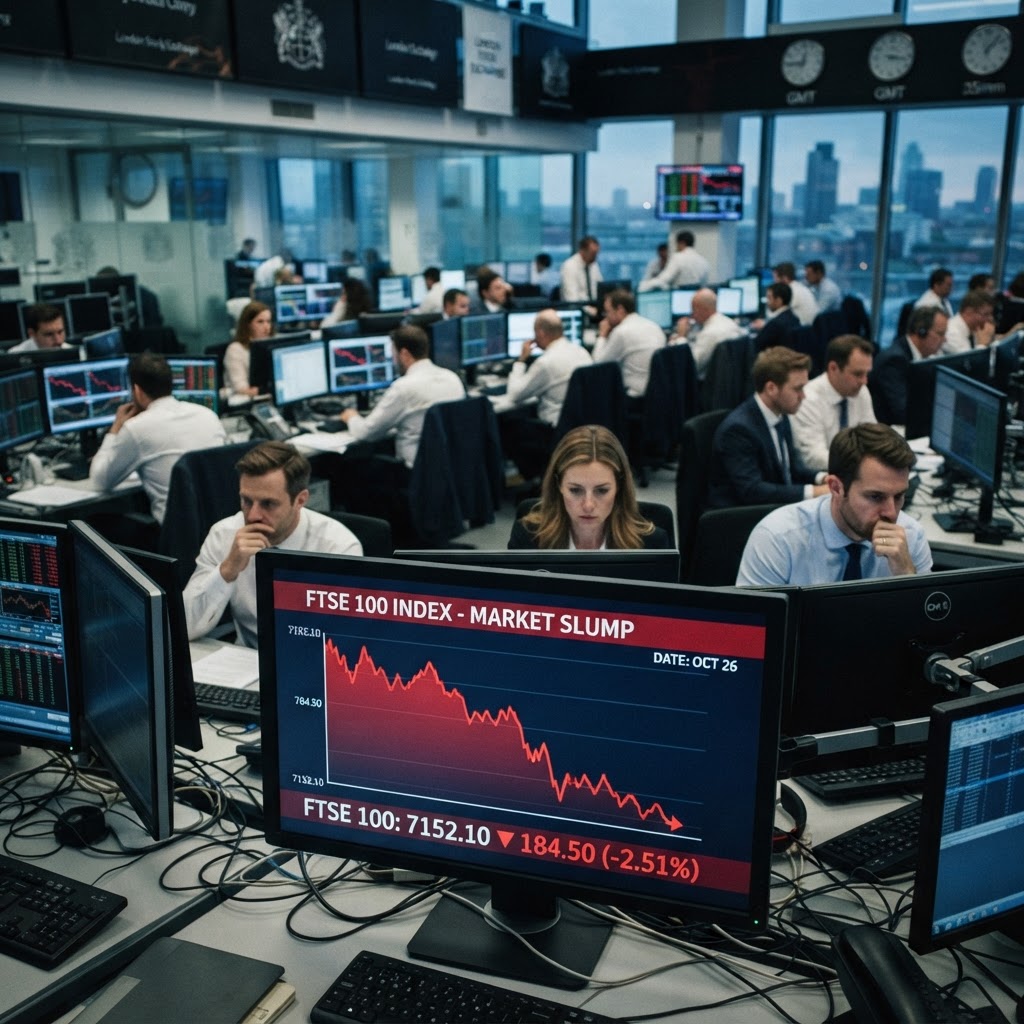
The FTSE 100 retreated 0.7 per cent in a session defined by pervasive risk aversion. While London markets proved more resilient than their continental peers, investors remain unsettled by the persistent volatility plaguing global technology stocks.
A Turbulent Session for the City
London’s blue-chip index, the FTSE 100, concluded trading on November 20 at 13,584 points, marking a 0.7 per cent decline as investors fled to the safety of bonds and defensive assets. The drop, while significant, saw the index trim deeper losses that had exceeded 1 per cent during a volatile intraday session. The afternoon recovery offered little solace to traders, who are increasingly concerned that the foundations of the current equity rally are beginning to fracture.
The European Contagion
The malaise was not confined to the Square Mile. Across the Channel, the selling pressure proved significantly more acute. Germany’s DAX bore the brunt of the downturn, plummeting 2.2 per cent as concerns regarding the manufacturing sector’s output exacerbated broader market fears. France’s CAC 40 also struggled, ending the day 0.99 per cent lower. The synchronised nature of these declines reflects a hardening 'risk-off' sentiment that has transcended national borders, leaving few sectors untouched by the prevailing pessimism.
The Technology Tailwind Runs Dry
At the heart of this week’s turbulence lies a sharp correction within the technology sector. After months of stellar valuations supported by artificial intelligence optimism and robust capital expenditure, the momentum has stalled. Major technology constituents, which have previously carried the burden of maintaining index performance, have faced sustained selling pressure over the past five sessions. Market analysts suggest that investors are now reassessing the astronomical price-to-earnings ratios that have defined the tech space throughout 2026. This rotation away from growth-oriented equities is indicative of a broader shift in market psychology, where caution has replaced the speculative exuberance seen earlier in the year.
Economic Undercurrents and Inflationary Fears
Beyond the tech rout, macro-economic anxieties continue to weigh heavily on the minds of institutional investors. Despite signs of stabilising inflation in the United Kingdom, the persistent strength of the labour market has left the Bank of England with little room to manoeuvre regarding interest rates. 'The market is grappling with a dual narrative of persistent economic resilience and the looming reality of higher-for-longer borrowing costs,' notes Sarah Jenkins, a senior market strategist at Sterling Capital. She argues that the recent sell-off is a necessary, if painful, re-evaluation of asset prices in an environment where capital is no longer cheap.
The Path Forward for London
Despite the current climate of apprehension, some analysts suggest that the FTSE 100 is better positioned than many of its global counterparts. With a heavy weighting towards energy, mining, and financial services, the London market often acts as a defensive play during periods of high volatility. However, the reliance on these traditional sectors may not be enough to shield investors if global trade volumes contract significantly. As the year draws to a close, market participants will be watching the upcoming corporate earnings season with eagle eyes, looking for evidence of margin resilience in the face of cooling consumer demand.
Conclusion
As the closing bell rang on Thursday, the mood on the trading floor was one of watchful waiting. The events of this week have served as a sharp reminder that equity markets are rarely linear. Investors are now forced to reconcile with the fact that the easy gains of the summer months have given way to a more demanding environment, one defined by uncertainty and the need for rigorous stock picking over broad index exposure.