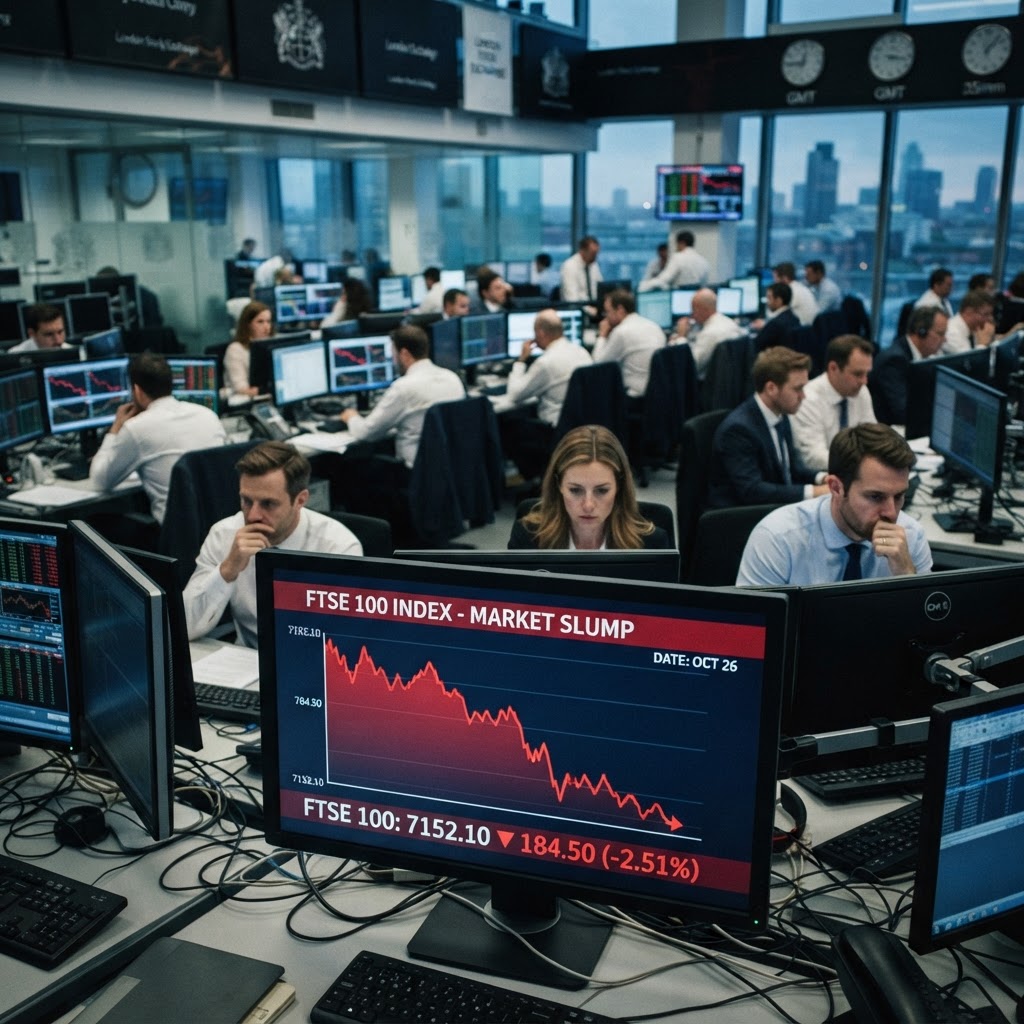
The FTSE 100 has slumped to a five-month nadir, reflecting mounting investor anxiety over the viability of high-tech valuations. While global headwinds persist, underlying British economic data continues to defy predictions of a cooling trend.
A Watershed Moment for Risk Appetite
The blue-chip index of the London Stock Exchange endured a punishing session on Friday, as the FTSE 100 succumbed to a broader global contagion. Closing at 10,346.34, a decline of 106.34 points, the benchmark reached its lowest point since June. The broader sentiment, however, was encapsulated by the FTSE 250, which bore the brunt of the selling pressure, finishing 2.2 per cent lower at 23,651.73. For traders on the floor, the mood was distinctly sombre, marking a fourth consecutive day of losses that has effectively wiped out the gains of the preceding quarter.
The Shadow of the Silicon Valley Correction
At the epicentre of the turbulence was the much-anticipated public offering of artificial intelligence giant Anthropic. Market watchers had long pinned their hopes on the debut as a bellwether for the durability of the AI investment cycle. Instead, the lukewarm reception served as a catalyst for a wider reassessment of risk. Investors who had previously piled into technology stocks with little regard for fundamental valuations are now engaging in a swift, defensive rotation. The concern is that the capital expenditure required to sustain AI dominance is beginning to outpace actualised revenue, leading to fears of an impending valuation bubble burst.
Commodities and the Mining Drag
Compounding the tech-induced malaise was a stark decline in the mining sector, a traditional stalwart of the London market. Heavyweights such as Rio Tinto and Anglo American led the exodus as copper prices resumed their downward trajectory. The red metal, often regarded as a proxy for global industrial health, has struggled to find a floor amidst persistent uncertainty regarding manufacturing output in key Asian markets. As global liquidity tightens, the reliance on cyclical commodities is proving to be a vulnerability that institutional investors are currently unwilling to ignore.
Domestic Resilience Amid External Storms
Yet, to view the current market climate purely through the lens of a broader sell-off would be to overlook a more nuanced reality within the British Isles. Despite the volatility in the capital markets, the domestic economic indicators released this week offered a surprising degree of solace. Retail sales figures for October exceeded analyst expectations, suggesting that the British consumer remains remarkably robust despite interest rate pressures. Furthermore, the Office for National Statistics confirmed that government borrowing for the same period was lower than forecast, providing the Chancellor with a modicum of fiscal breathing space. This dichotomy between the frenetic movements of the stock market and the measured, resilient performance of the real economy presents a curious dilemma for the Bank of England as it approaches its next monetary policy meeting.
Looking Toward a Cautious Horizon
As the trading week concludes, the narrative is one of correction rather than collapse. However, the five-month low serves as a stark reminder that the era of unfettered growth in AI-adjacent equities is facing a reality check. Analysts at leading City firms now predict that investors will demand higher dividends and more tangible evidence of profitability before returning to previous levels of exposure. The focus for the coming weeks will remain on whether the resilience in the domestic UK economy can act as a sufficient buffer against the deteriorating mood in global financial centres. For now, the sentiment remains cautious, with the FTSE 100 likely to face further testing of its support levels as global investors wait for a fresh catalyst to reset their risk appetite.