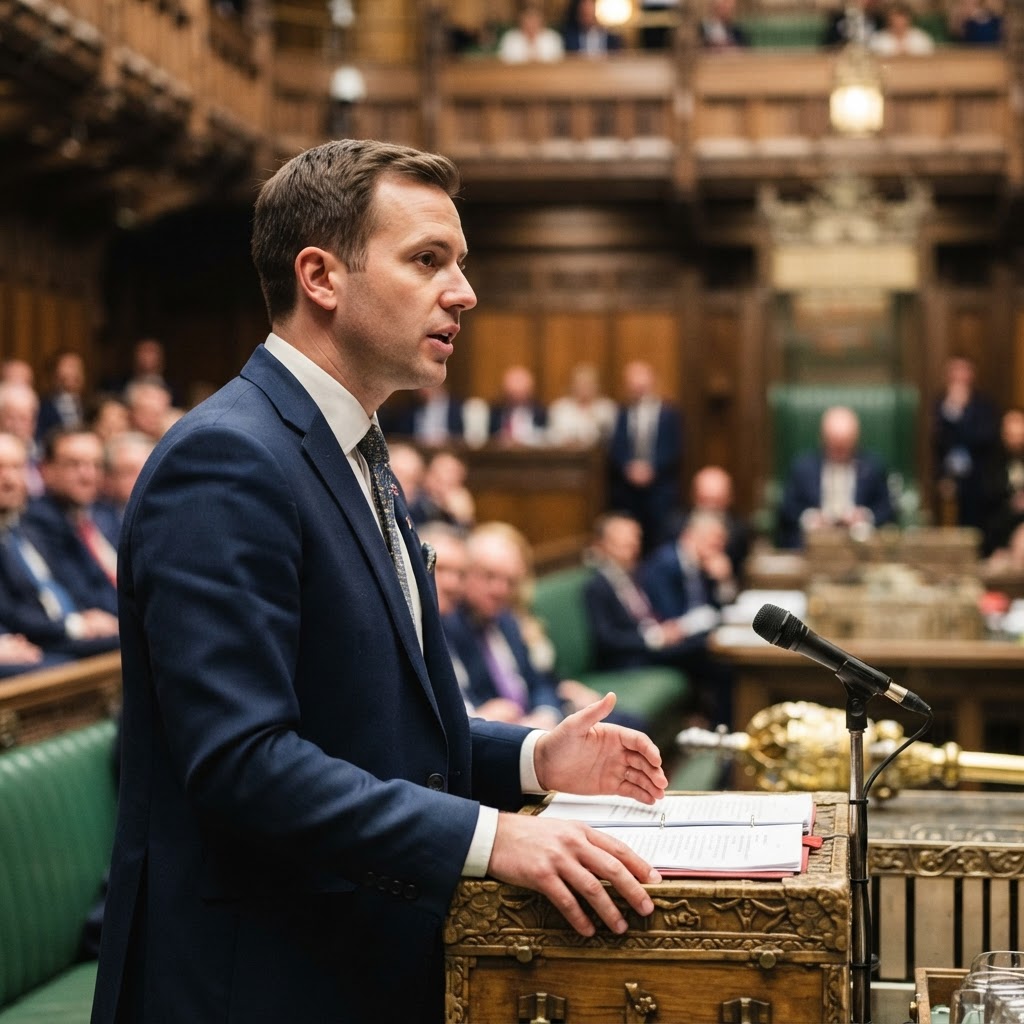
MPs have gathered to address the mounting pressures of regulating advanced artificial intelligence. The debate highlights an increasingly fragile consensus between fostering economic growth and securing the safety of the nation.
The Challenge of Oversight
In the ornate, wood-panelled chambers of the House of Commons, the discourse surrounding artificial intelligence shifted on 19 November 2026 from abstract theoretical potential to urgent legislative necessity. Initiated by Ben Lake MP, the debate underscored a palpable anxiety permeating the benches: the fear that the pace of technological development in the private sector has significantly outstripped the government’s capacity for oversight. The session serves as a stark reminder that while the UK remains a global leader in AI research, the infrastructure required to govern its most potent manifestations remains in a state of infancy.
Guardrails and Global Ambitions
Central to the afternoon’s deliberations was the recent 'Guardrails for growth' report issued by the Business, Innovation, Science and Trade Committee. The committee's findings present a sober assessment of the sector, suggesting that the UK cannot merely rely on the benevolence of frontier labs to ensure safety. Instead, there is a mounting cross-party desire to codify ethical standards and safety protocols into law. Mr Lake argued that the current regulatory vacuum is not merely a technical oversight, but a failure to address the potential for societal disruption. Lawmakers articulated a clear consensus: artificial intelligence must be harnessed for public good, from revitalising the National Health Service to driving industrial productivity, yet such utility must not be purchased at the cost of unforeseen systemic instability.
The Investment Paradox
The government’s position remains nuanced, attempting to reconcile a pro-innovation narrative with the growing demands for restraint. Only weeks prior, the Department for Science, Innovation and Technology announced the appointment of twenty new Turing AI Fellows, supported by an injection of £39 million in public funding. This initiative signals an enduring commitment to academic excellence and domestic talent retention. However, this investment also complicates the legislative task at hand. If the state is effectively the primary patron of domestic AI development, it assumes a greater responsibility for the outcomes of that research. During the debate, several members questioned whether the funding criteria sufficiently prioritise safety-aligned research over raw performance metrics, which often incentivise the creation of increasingly complex, yet opaque, neural architectures.
Expert Dissent and Future Risks
The anxiety within Westminster reflects a broader shift in the international expert community. Throughout 2026, concerns regarding the speed at which Large Language Models and subsequent iterative systems are evolving have become mainstream. Where researchers once discussed machine learning as a series of benign statistical functions, the focus has shifted toward the unpredictability of 'emergent capabilities.' These are functionalities—often related to reasoning, coding, or autonomous decision-making—that manifest only once a model reaches a certain scale of compute. For parliamentarians, the risk is not merely the misuse of technology by bad actors, but the potential for loss of control over systems that are increasingly autonomous.
The Path Ahead
As the debate concluded, the path forward remained unsettled. The government has resisted calls for a dedicated, draconian 'AI Act,' preferring a sector-specific regulatory approach that empowers existing bodies like the Competition and Markets Authority and the Health and Safety Executive. Yet, as the year draws to a close, the pressure for a unified, comprehensive legislative framework is mounting. The argument is no longer about whether to regulate, but how to do so without stifling the very innovation the UK seeks to lead. Whether the Turing AI Fellows and their peers will be given the space to innovate safely, or whether they will be caught in a web of restrictive, reactive red tape, remains the defining tension of this parliamentary term.