National Post UK
Bailey Refuses to Commit as Inflationary Pressure Mounts in Britain

The Governor of the Bank of England has cautioned that interest rate policy remains data-dependent as rising living cost

The National Post

HomeFinance
Finance

Bailey Refuses to Commit as Inflationary Pressure Mounts in Britain

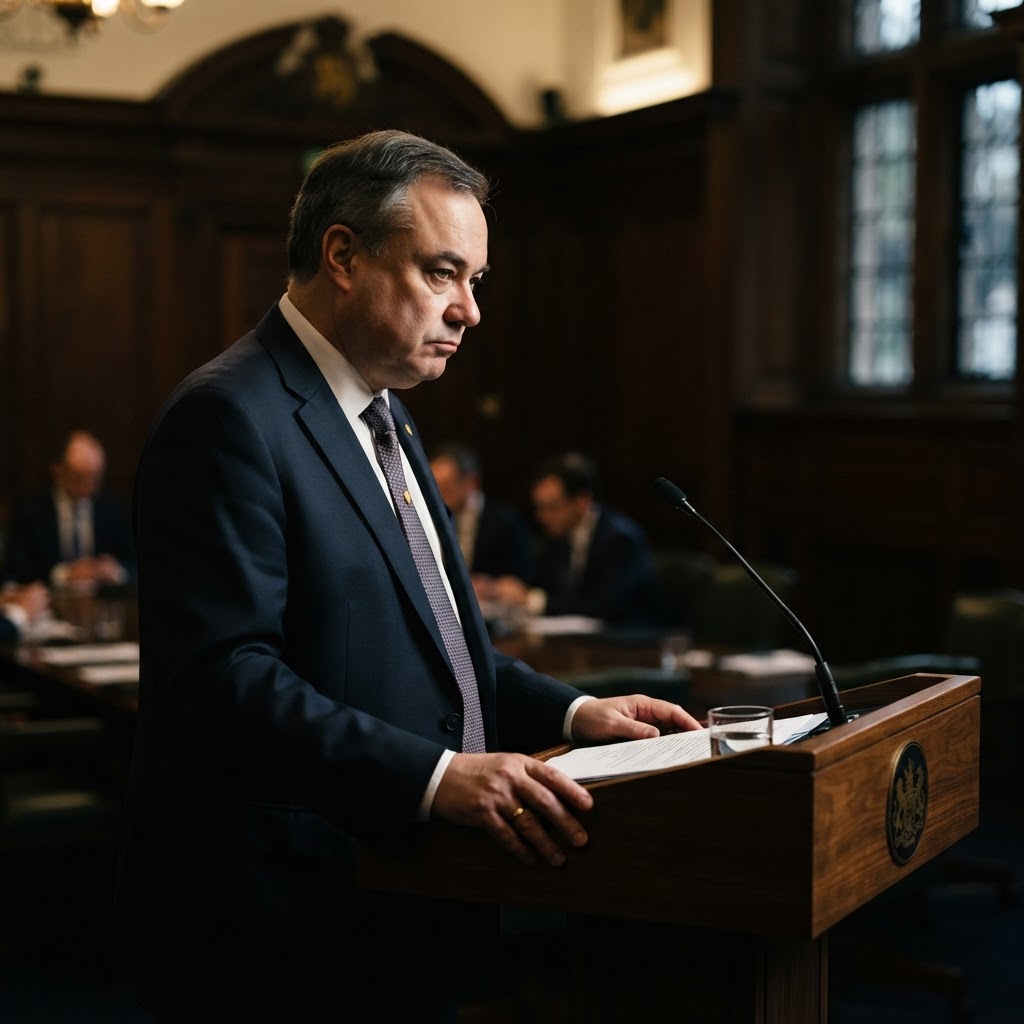
The Governor of the Bank of England has cautioned that interest rate policy remains data-dependent as rising living costs challenge the recent economic resurgence. With markets pricing in a hike before Christmas, the Monetary Policy Committee faces a delicate balancing act.

CW

Charlotte Webb

Finance Correspondent

Published 20 November 2026·about 1 hour ago 4 min read
Text
Share

A Period of Heightened Uncertainty The Bank of England has moved to temper market expectations as the United Kingdom confronts a renewed wave of inflationary pressure. Governor Andrew Bailey, speaking from Threadneedle Street on Thursday, explicitly rejected the notion of a 'pre-set path' for monetary policy, underscoring that the Monetary Policy Committee (MPC) will maintain complete flexibility when it convenes in mid-December. The remarks arrive at a juncture where the economic narrative is becoming increasingly bifurcated: while the domestic growth story has outperformed initial forecasts, the spectre of stubborn inflation continues to loom over the British consumer.

The Inflationary Tailwind Data released earlier this week confirmed that the Consumer Price Index (CPI) climbed to 3.6 per cent in October, marking a slight but significant acceleration from September’s 3.5 per cent. The underlying drivers of this rise are predominantly external, with the escalating geopolitical volatility in the Middle East once again exerting upward pressure on energy markets. Diesel prices, in particular, have reached near-record levels, creating a cascading effect through supply chains that is inevitably passed down to the end user. This trend has complicated the Bank’s mandate to anchor inflation expectations firmly at the two per cent target.

Economic Resilience Amid Headwinds Despite these inflationary headwinds, the UK economy has demonstrated a surprising degree of fortitude. Recent revisions to national accounts suggest that annual GDP growth is now on track to reach 1.6 per cent, a figure that would have seemed optimistic at the turn of the year. This buoyancy has been driven in large part by the burgeoning technology and artificial intelligence sectors, which have provided a structural tailwind to productivity and investment. Such robust performance is, however, a double-edged sword; while it indicates an economy capable of withstanding higher borrowing costs, it also limits the Bank’s room for manoeuvre should it wish to stimulate activity further.

The December Dilemma As the 17 December meeting approaches, the financial markets are telegraphing a distinct sense of urgency. Current market-implied data suggests a 78 per cent probability of a 19 basis point rate hike. Institutional investors, wary of the persistent nature of energy-led inflation, appear to have priced in a hawkish shift as the most likely outcome. Yet, Mr Bailey’s insistence on data dependency serves as a deliberate corrective to this consensus. The Governor is keenly aware of the risk of overtightening—of choking off the nascent growth observed in the tech sector through a policy that may be too reactive to volatile short-term energy spikes.

Expert Perspectives Economists are divided on the optimal path forward. Some analysts suggest that the Bank must act decisively to maintain credibility, arguing that failing to raise rates in the face of 3.6 per cent inflation could signal a lack of resolve. Conversely, others maintain that the energy-driven component of current inflation is exogenous and beyond the reach of traditional monetary policy. They argue that raising interest rates would punish households already strained by cost-of-living pressures without addressing the fundamental cause of the price hikes. As the MPC prepares for its final decision of the year, the tension between these two schools of thought will be the defining feature of the debate.

Looking Toward the Horizon The coming weeks will be crucial. The MPC will be scrutinising everything from wage growth data to consumer sentiment surveys, attempting to determine whether the recent rise in inflation is a transient blip or a signal of a more entrenched trend. For households and businesses alike, the message from Threadneedle Street is clear: the era of predictable policy trajectories has ended. The Bank is keeping its cards close to its chest, waiting for the latest economic indicators to dictate its next move.

TopicsBank of EnglandInflationInterest RatesUK EconomyAndrew BaileyFinance
Share

About the Author

CW

Charlotte Webb

Finance Correspondent

Charlotte Webb reports for National Post UK with a focus on rigorous analysis and authoritative journalism — a trusted voice across British public life.

Reader Discussion · 11

Subscribers can join the conversation.

SUBSCRIBE TO COMMENT →
M
Mark Sterling20 Nov

The uncertainty is exactly what is spooking the markets. We need a clear signal on interest rates so that businesses and families can plan their finances for the next twelve months.

F
Fiona Campbell20 Nov

The global factors driving this are mostly out of the Bank's control anyway. It is unrealistic to expect Threadneedle Street to single-handedly fix supply chain issues and energy costs.

D
David Thorne20 Nov

Bailey is right to be cautious, but the Bank should have been more proactive months ago. Waiting until inflation is firmly embedded before tightening further feels like shutting the stable door after the horse has bolted.

S
Sarah Jenkins20 Nov

Prudent or not, my household budget is being decimated by these price hikes. We need more than just vague reassurances from the Bank of England while the cost of living continues to spiral.

A
Arthur Penhaligon20 Nov

It is prudent for the Governor to avoid locking himself into a pre-set path when the economic data remains so volatile. Markets are far too quick to demand certainty where none can exist.

R
Robert Miller20 Nov

I find the lack of clear guidance quite frustrating for small businesses planning for the next quarter. We need some level of predictability to invest and grow with any confidence.

J
James H. Croft20 Nov

The issue is that global supply chain disruptions are still largely outside of Bailey's control. Even if he keeps rates high, we are essentially at the mercy of international energy prices.

E
Elaine Patterson20 Nov

My weekly shop has increased by nearly 20 percent this year alone. They can talk about inflationary pressure all they like, but families are struggling right now and need actual solutions.

M
Marcus Thorne20 Nov

This is exactly the right approach. The economy is far too volatile right now for any pre-set path, and the Bank must retain the flexibility to react to data as it comes.

S
Sarah Jenkins20 Nov

I agree that we need caution, but I worry about the impact on mortgage holders. Another rate hike will push many of us to the absolute brink.

D
David Sterling20 Nov

It is about time the Bank of England stopped trying to pacify the markets with vague promises. Bailey needs to be firmer if we are to have any hope of curbing this cost of living crisis.


More from Finance

Most Read in Finance

Morning Briefing

The day's top stories, before 7am

Join 40,000 readers who start their morning with National Post UK.