National Post UK
Mining Rout and Semiconductor Curbs Drag FTSE 100 into Negative Territory

London’s blue-chip index retreated on Tuesday as geopolitical tensions weighed on technology stocks. Despite signs of re

The National Post

HomeFinance
Finance

Mining Rout and Semiconductor Curbs Drag FTSE 100 into Negative Territory

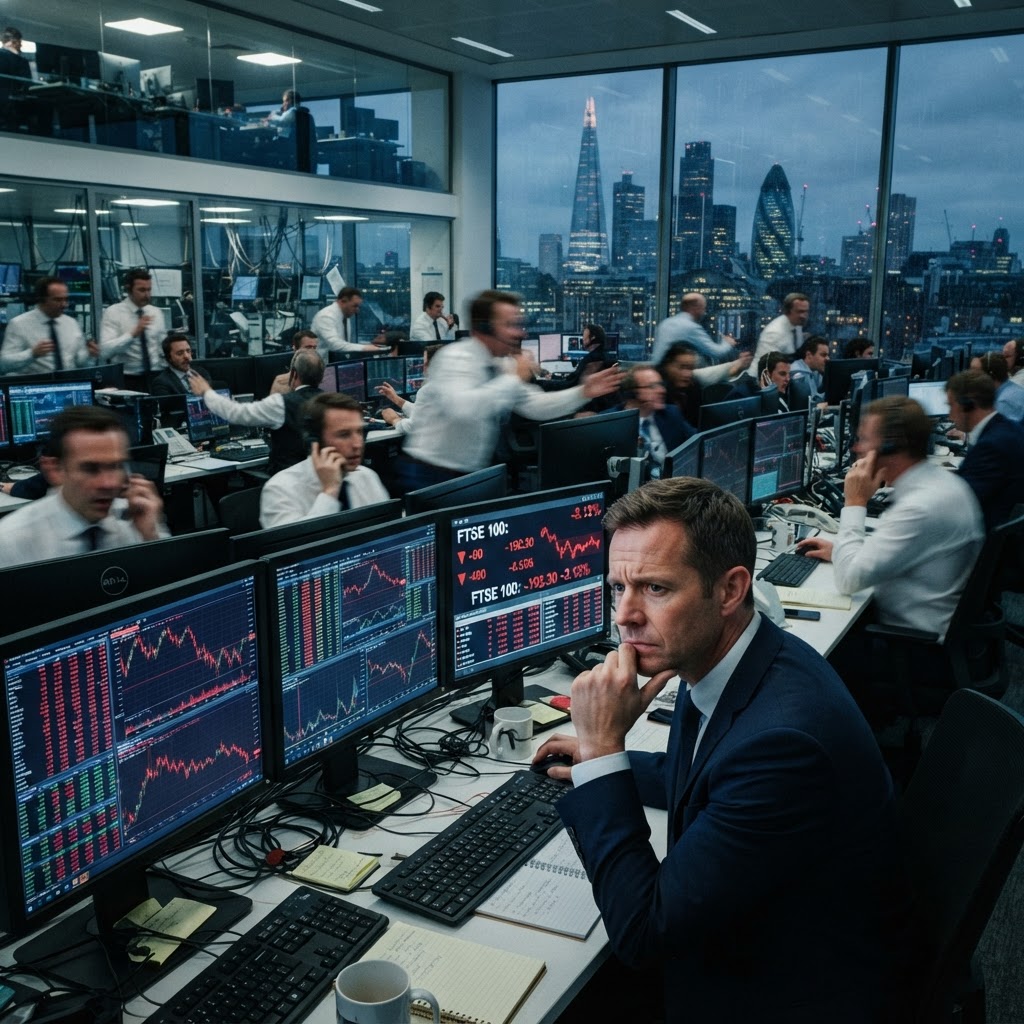
London’s blue-chip index retreated on Tuesday as geopolitical tensions weighed on technology stocks. Despite signs of resilience in the domestic labour market, broader market sentiment remains fragile.

AP

Alice Pemberton

Finance Correspondent

Published 18 November 2026·about 7 hours ago 3 min read
Text
Share

A Turbulent Session for London Markets The FTSE 100 experienced a distinct cooling of sentiment during Tuesday’s trading session, shedding 78.60 points, or 0.72 per cent, to close at 10,802.95. This decline reflects a broader recalibration of investor risk appetite as international trade tensions intersect with domestic economic performance. While the index continues to operate well within its established 52-week range of 9,423.90 to 10,989.50, the sharp movement in the mining sector highlights a vulnerability to global shifts in industrial demand.

The Weight of Geopolitics on Tech Much of the downward pressure was attributed to the latest round of US chip-export controls, a strategic tightening that has reverberated across global equity markets. The restrictions, aimed at limiting the proliferation of advanced computing technology, have sent tremors through the semiconductor supply chain, impacting the portfolios of institutional investors who had previously sought refuge in growth-oriented tech stocks. The sudden shift in Washington’s policy has prompted a flight to safety, with many participants re-evaluating their exposure to sectors heavily reliant on international trade channels.

Mining Sector Drag The mining industry, often considered the bellwether for global growth, bore the brunt of the session’s volatility. Commodity prices have come under renewed scrutiny as the prospect of constrained export growth threatens to dampen industrial output in key markets. London-listed mining giants saw significant red ink on their balance sheets, pulling the wider index downward as investors moved to consolidate positions in the face of persistent uncertainty. Analysts have noted that while individual firms maintain robust balance sheets, the overarching macro environment is currently unfavourable for base metal exploration and production.

Resilience in the UK Labour Market In spite of the prevailing gloom, there remained glimmers of hope within the domestic sphere. Fresh UK employment data released earlier this morning provided a necessary cushion, suggesting that the labour market retains a level of resilience that many had feared would dissipate by late 2026. The uptick in job creation and steady wage growth offered a counter-narrative to the bearish outlook, providing a degree of support that prevented a more substantial decline in the FTSE’s value. However, the influence of these domestic indicators was ultimately eclipsed by the gravitational pull of global trade anxieties.

Looking Ahead As we move toward the year-end, the primary challenge for the FTSE 100 will be balancing these conflicting narratives: domestic economic stability versus the unpredictable nature of international trade sanctions. For investors in London, the coming weeks will likely be defined by a focus on corporate earnings and central bank commentary. There is a palpable sense of caution among market participants who, having witnessed the index flirt with its 52-week highs, are now choosing to adopt a more defensive stance until a clearer path for global commerce emerges.

TopicsFTSE 100MiningUS Chip ControlsMarketsUK Economy
Share

About the Author

AP

Alice Pemberton

Finance Correspondent

Alice Pemberton reports for National Post UK with a focus on rigorous analysis and authoritative journalism — a trusted voice across British public life.

Reader Discussion · 12

Subscribers can join the conversation.

SUBSCRIBE TO COMMENT →
M
Margaret Hughes18 Nov

I have been watching these mining stocks for years and this feels like a temporary correction rather than a long-term trend. The fundamental value is still there if you look past the headlines.

J
James Miller18 Nov

A 0.72 per cent drop is hardly a disaster in the grand scheme of things. We have seen much worse corrections in previous years, so let us not get too carried away with the doom and gloom.

E
Elizabeth Croft18 Nov

I am not sure why everyone is so surprised by this dip. When you have trade restrictions affecting major industries, the markets are bound to pull back until there is more clarity.

D
David Thorne18 Nov

The mining sector is clearly reacting to the weaker demand signals from China. It is a cyclical business, but it never makes for a pleasant day on the trading floor.

S
Sarah Jenkins18 Nov

Another day of red numbers for my pension fund. At this point, I am just holding steady and hoping for a rebound by the end of the quarter.

A
Arthur Penhaligon18 Nov

It was only a matter of time before the semiconductor supply chain issues caught up with the FTSE. Given how interconnected global tech is, I suspect we might see a bit more volatility in the coming weeks.

J
James Sinclair18 Nov

It is worth noting that the FTSE has had a decent run lately, so a bit of profit-taking was always on the cards. I would not call this a rout just yet, more of a healthy rebalancing.

E
Eleanor Rigby18 Nov

The market is clearly reacting to the uncertainty surrounding international trade policy. It is a prudent move for investors to take a step back until we get some clarity on the geopolitical front.

D
David Lloyd18 Nov

I have been holding onto my mining stocks for years, but this latest volatility is starting to test my patience. I suppose it is a good time to review my portfolio strategy before things slide further.

M
Marcus Thorne18 Nov

I am not so sure this is just a minor correction. With the ongoing trade tensions, these semiconductor curbs could have a much longer-term impact on our industrial output than the analysts are currently projecting.

S
Sarah Jenkins18 Nov

Just another day of the FTSE shuffling around while the average worker struggles with the cost of living. None of these market fluctuations seem to reflect the reality on the high street.

A
Arthur Penhaligon18 Nov

It was inevitable that the mining sector would take a hit given the global economic cooling we have been seeing. Investors are simply moving capital into safer harbours until the semiconductor supply chain stabilises.


More from Finance

Most Read in Finance

Morning Briefing

The day's top stories, before 7am

Join 40,000 readers who start their morning with National Post UK.