National Post UK
City Braces for Volatility as Bank of England Poised to Break Policy Stasis

The FTSE 100 retreated on Tuesday as investors weighed the prospect of a quarter-point rate hike against a backdrop of e

The National Post

HomeFinance
Finance

City Braces for Volatility as Bank of England Poised to Break Policy Stasis

The FTSE 100 retreated on Tuesday as investors weighed the prospect of a quarter-point rate hike against a backdrop of escalating Middle East tensions. Market participants are now focused on whether Thursday’s decision signals the beginning of a sustained tightening cycle.

CW

Charlotte Webb

Finance Correspondent

Published 4 November 2026·about 4 hours ago 3 min read
Text
Share

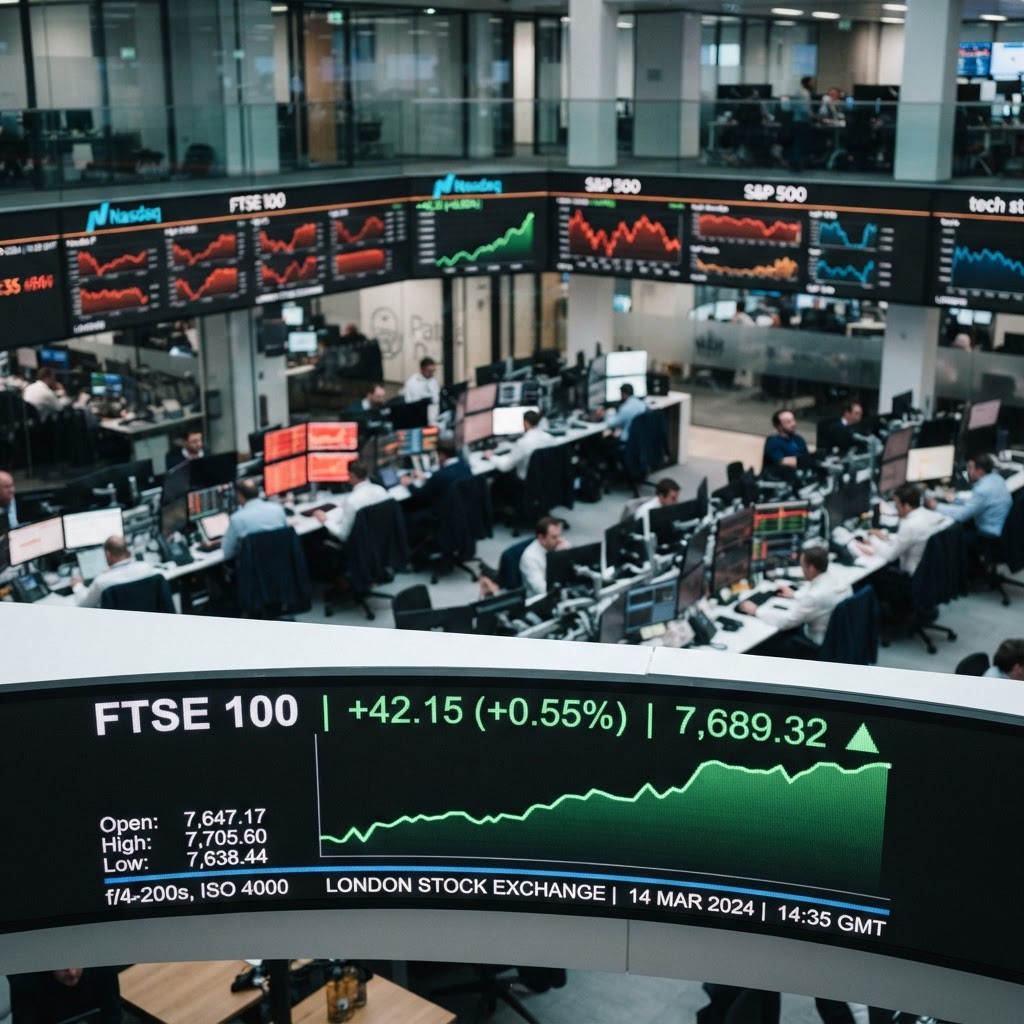
A Retrenchment in the Square Mile The London stock market experienced a sharp reversal on Tuesday, as the FTSE 100 shed 96.16 points to close at 10,665.17, a decline of 0.89 per cent. The retreat reflects a prevailing sense of apprehension among institutional investors, who are currently recalibrating their portfolios ahead of the Bank of England’s crucial Monetary Policy Committee (MPC) announcement scheduled for 5 November. This dip in equity values marks a departure from the cautious optimism that has characterised the latter half of the autumn, as the specter of higher borrowing costs begins to weigh heavily on corporate balance sheets.

The Return of Monetary Tightening Expectations are firmly anchored around a 25 basis point increase, which would elevate the Bank Rate from 3.75 per cent to 4.0 per cent. Should the MPC proceed with this adjustment, it will represent the first hike since August 2023, effectively ending a lengthy period of relative stability in interest rate policy. For households and businesses alike, the move signals a definitive pivot in the central bank’s approach to inflation control, which has proven more stubborn than initial models had projected. Economists are particularly focused on the accompanying inflation report and the voting split, which may provide clues as to whether the Committee envisions this hike as a singular measure or the vanguard of a broader tightening trajectory.

Geopolitical Headwinds Compound Uncertainty Beyond the domestic macroeconomic landscape, the sentiment in the City has been further darkened by renewed geopolitical friction. News of fresh US strikes against Iran has introduced a premium of uncertainty into global energy markets, prompting a flight to safety among risk-averse investors. The correlation between international stability and domestic equity performance has become increasingly pronounced, with traders wary that a protracted conflict could exacerbate supply chain pressures and heighten inflationary risks. In such an environment, the Bank of England finds itself in a precarious position, tasked with managing inflation while ensuring the fragility of the post-recovery economic landscape is not compromised by overly aggressive policy tightening.

Market Outlook and the Path Ahead The debate among market participants remains fierce regarding the long-term outlook for the British economy. While some analysts argue that a move to 4.0 per cent is necessary to anchor long-term inflation expectations, others caution that the move could stifle the tentative growth seen in the services sector over the last quarter. As investors prepare for the decision tomorrow, the focus will not merely be on the headline rate, but on the rhetoric from Governor Andrew Bailey. The language utilized in the press conference will be scrutinised for any indication that the MPC is prepared to pause future increases, or if the central bank is bracing for an era of sustained, higher-for-longer interest rates. For now, the London market remains in a state of watchful waiting, with trading volumes expected to remain subdued until the monetary policy path becomes significantly clearer.

TopicsFTSE 100Bank of EnglandInterest RatesFinanceUK EconomyMonetary PolicyGeopolitics
Share

About the Author

CW

Charlotte Webb

Finance Correspondent

Charlotte Webb reports for National Post UK with a focus on rigorous analysis and authoritative journalism — a trusted voice across British public life.

Reader Discussion · 8

Subscribers can join the conversation.

SUBSCRIBE TO COMMENT →
E
Eleanor Rigby4 Nov

The underlying issue is that inflationary pressures are still far too sticky for the Bank to comfortably pivot. Until the data shows a clear downward trend, this stasis is probably the safest bet.

D
David Sterling4 Nov

I am staying the course with my current investments despite the jitters. You cannot time the market perfectly, and panicking during a 0.89 per cent dip is usually a mistake.

M
Marcus Thorne4 Nov

It is worth noting that a correction was inevitable given the overvaluation in the mining sector recently. I am not sure the Bank of England is entirely to blame for what looks like a overdue market adjustment.

D
David Thorne4 Nov

As someone nearing retirement, this volatility is incredibly stressful for my pension pot. I really hope they consider the impact on long-term savers before making any sudden moves with rates.

S
Sarah Jenkins4 Nov

As someone relying on my pension pots, this volatility is incredibly stressful to watch. I wish they would just pick a strategy and stick to it so we can have some stability.

S
Sarah Jenkins4 Nov

I am not sure why everyone is so panicked about a sub-one percent drop. Markets breathe in and out, and this feels more like a necessary correction than a sign of impending doom.

A
Arthur Penhaligon4 Nov

It feels like we have been stuck in this holding pattern for months. The Bank of England really needs to show some decisive leadership rather than just keeping everyone guessing.

A
Arthur Penhaligon4 Nov

The Bank of England really has left it too late to act. Their indecision over the last few months has created this atmosphere of uncertainty that is now dragging the FTSE down.
More from Finance

Most Read in Finance

Morning Briefing

The day's top stories, before 7am

Join 40,000 readers who start their morning with National Post UK.