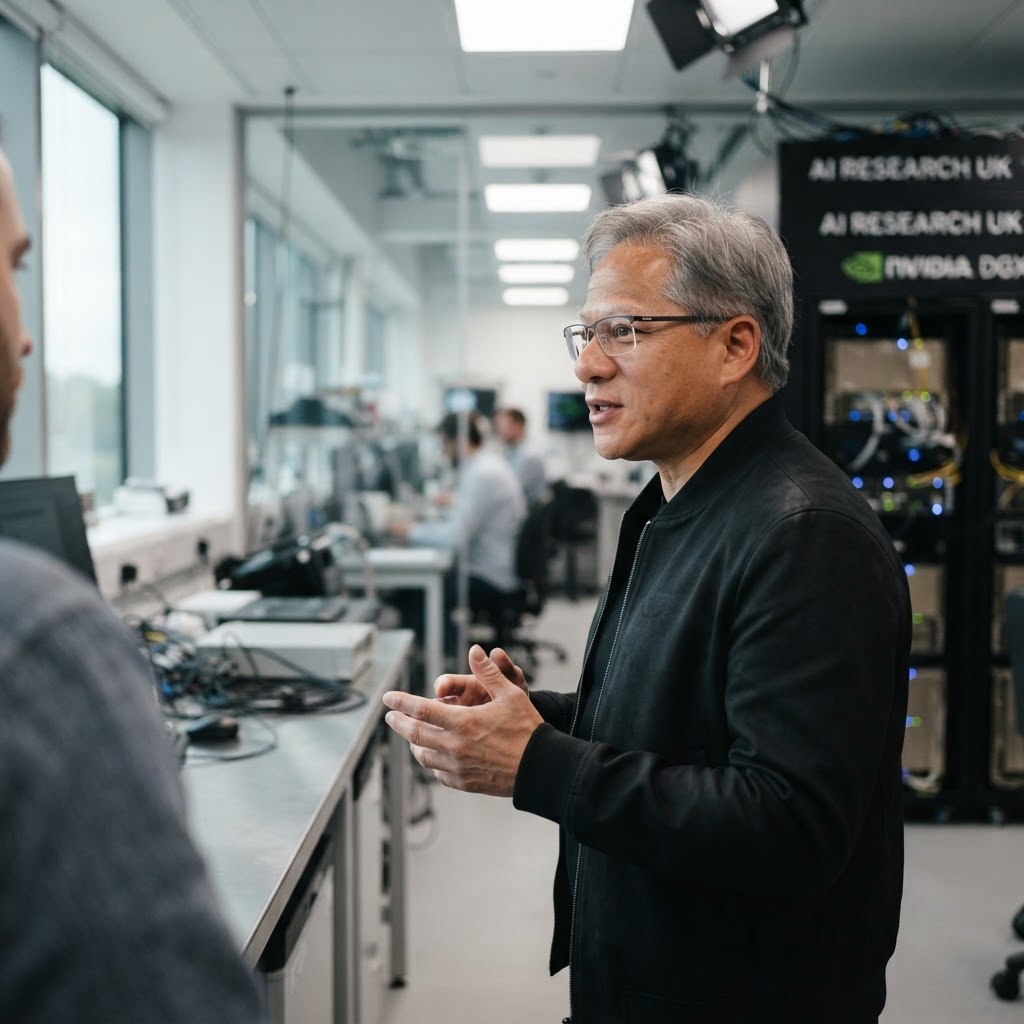
A Strategic Pivot Toward Security In a move that signals the increasing convergence of high-performance computing and defensive software architecture, Nvidia has unveiled a £192 million ($250 million) funding initiative targeting five of the United Kingdom’s most promising deep-tech startups. The investment, announced on Thursday in London, represents one of the most significant private capital injections into the British artificial intelligence sector this year. Rather than chasing the hype of large language models alone, this partnership focuses squarely on the maturation of 'agentic AI'—the next iteration of autonomous systems capable of executing complex, multi-step tasks without constant human intervention.
As these systems become embedded into the infrastructure of banking, energy management, and national supply chains, the imperative for robust safety protocols has transitioned from a theoretical concern to a commercial and national security necessity. Nvidia’s decision to plant this flag in the UK underscores a recognition that Britain’s academic pedigree in algorithmic theory is matched only by its nascent, yet robust, commitment to AI safety governance.
The Rise of the Autonomous Agent Agentic AI represents a paradigm shift from traditional tools that merely process information to agents that take action. While the efficiency gains for enterprise software are monumental, so too are the risks associated with loss of control. If an agent tasked with optimising a grid network makes an incorrect assumption, the consequences could be systemic. It is within this friction between innovation and stability that the five selected British firms are operating.
Industry observers have noted that Nvidia’s involvement is unlikely to be merely philanthropic. By embedding its proprietary hardware architecture deep within the security layers of these startups, the chip manufacturer is effectively ensuring that its ecosystem remains the gold standard for the 'safe' AI of the future. The investment arrives as the UK government continues to carve out a unique position in the global AI landscape, balancing an investor-friendly regulatory environment with the proactive oversight necessitated by the Bletchley Park legacy.
Building a Resilient Ecosystem The funding package is not intended to create a closed loop of proprietary tech, but rather to foster an interoperable standard for AI security. Experts within the sector have long argued that the UK’s advantage lies in its unique concentration of mathematical research talent, particularly in the corridors between London, Oxford, and Cambridge. By providing these startups with both liquidity and access to Nvidia’s accelerated computing platforms, the deal aims to accelerate the commercialisation of safety frameworks that have previously languished in research labs.
Dr Eleanor Vance, a senior fellow at the Institute for Technological Stability, notes that the move is symptomatic of a broader maturation in the AI market. 'We are moving away from the wild west era of the last twenty-four months,' she says. 'The focus is shifting from simple generative capacity to the structural integrity of the agents themselves. Nvidia’s commitment recognises that the value of an AI agent is inversely proportional to its predictability; if you cannot prove it is safe, you cannot scale it in the enterprise sector.'
“The value of an AI agent is inversely proportional to its predictability; if you cannot prove it is safe, you cannot scale it in the enterprise sector.”
The Geopolitical Dimension Beyond the technical specifications, the investment serves as a vote of confidence in the British tech landscape despite intense competition from Silicon Valley and Shenzhen. As the UK navigates its post-Brexit economic identity, maintaining a lead in high-stakes deep-tech research has become a pillar of industrial strategy. The government’s recent signals regarding support for sovereign AI capabilities seem to have been heard loud and clear by the American tech giants.
Whether this investment will translate into a globally dominant safety protocol remains to be seen. However, by positioning the UK at the heart of the safety conversation, Nvidia has ensured that London will remain a focal point for the critical work of reconciling machine autonomy with human oversight. As the digital landscape continues to evolve, the ability to build 'responsible agents' may well prove to be the most valuable commodity in the global tech economy.