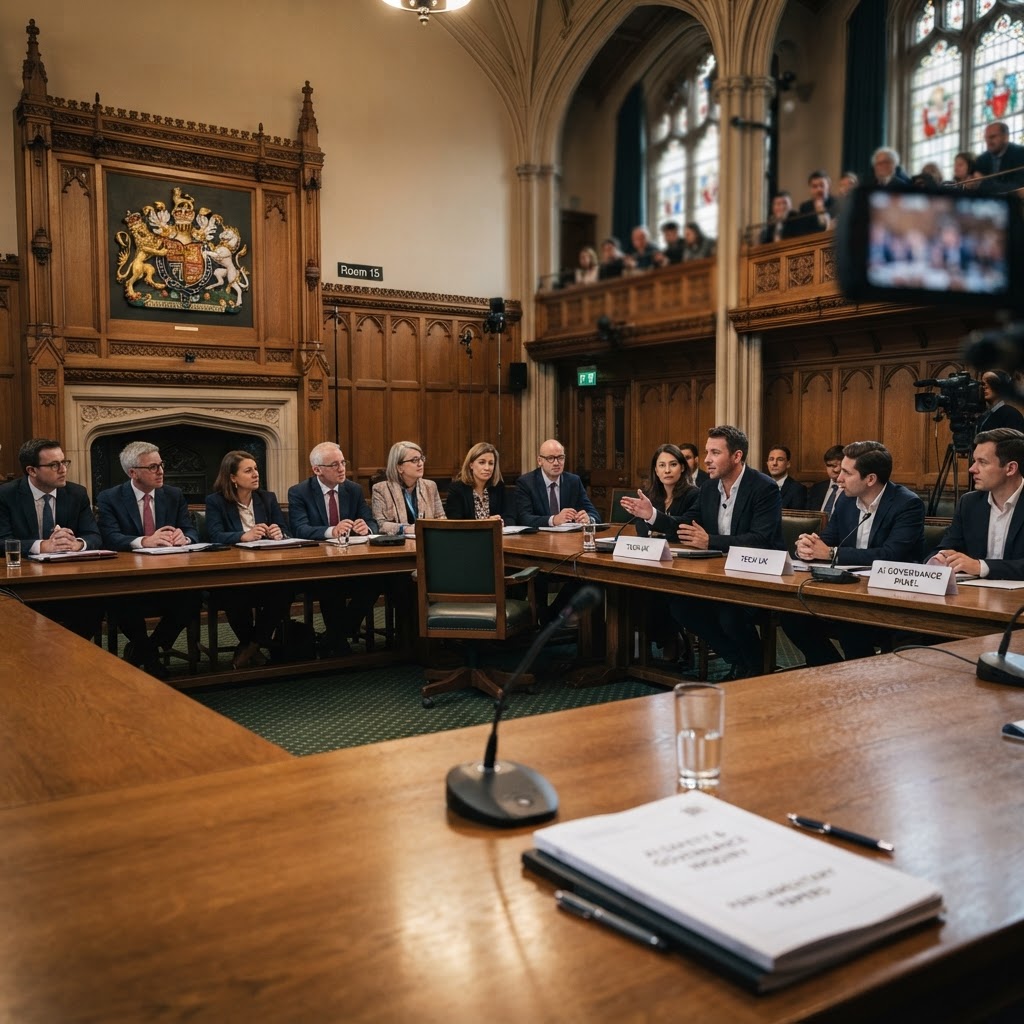
The Shadow of Catastrophic Risk In the ornate corridors of Westminster, the pace of technological development has finally caught the attention of the legislative vanguard. On 14 October 2026, the Business, Innovation, Science and Trade (BIST) Committee formally inaugurated a wide-ranging inquiry into the future of artificial intelligence. This is not merely a technical audit, but a fundamental interrogation of how the United Kingdom intends to govern the most transformative, and potentially disruptive, technology of the century. As the nation prepares to assume the presidency of the G20, the stakes could hardly be higher.
The inquiry arrives at a moment of profound public anxiety. While the commercial promise of generative AI has driven record investment into the UK’s tech sector, a darker narrative has emerged from within the heart of the frontier labs themselves. The committee’s opening sessions heard harrowing testimony from former employees of OpenAI and Anthropic, who spoke of a culture where speed often prioritises profit over the stringent safety protocols required to mitigate catastrophic risks. These witnesses, speaking with the clarity of those who have seen the internal mechanics of large-scale models, argued that voluntary compliance is no longer a viable framework for an industry growing at an exponential rate.
A Gathering of the Silicon Giants The committee’s roster of witnesses represents a veritable "who’s who" of the AI revolution. Alongside the whistleblowers, representatives from OpenAI, Anthropic, Meta, and Google DeepMind were subjected to rigorous questioning. They were joined by officials from the UK’s AI Security Institute—the body tasked with vetting the safety of frontier models before public deployment. The tension in the committee room was palpable, as lawmakers sought to reconcile the optimistic projections of the tech sector with the systemic anxieties voiced by safety researchers.
Rt Hon Liam Byrne, chairing the proceedings with a stern eye on the future of British regulation, noted that the government remains in a state of deliberative uncertainty. While there is a consensus that inaction is not an option, the precise form of intervention remains elusive. "The state has yet to decide on specific regulatory actions," Byrne noted, reflecting a Whitehall cautious of stifling innovation while simultaneously aware that it cannot be seen to be asleep at the wheel of a runaway machine.
Setting the Global Template The significance of this inquiry extends far beyond the borders of the United Kingdom. With the UK’s upcoming G20 presidency, the findings of this committee are set to become the bedrock of the nation's international diplomacy regarding digital governance. The government is acutely aware that the UK is in a unique position to influence global standards, potentially acting as the bridge between the heavy-handed regulation favoured by the European Union and the more permissive, market-led approach of the United States.
Experts have long argued that the UK possesses the intellectual capital and the regulatory credibility to lead in this arena. However, this relies on the domestic house being in order. If the UK is to advocate for robust global governance, it must first establish clear, enforceable rules that govern its own domestic labs. The prospect of "AI sovereignty"—a concept gaining traction in Conservative and Labour circles alike—suggests a future where Britain defines the ethical and safety parameters of the models deployed within its jurisdiction, regardless of their origin.
“The state has yet to decide on specific regulatory actions, and we must ensure that our legislative framework is as dynamic as the technology we seek to govern.”
The Road Ahead As the inquiry progresses, the BIST Committee will continue to gather evidence on the economic, societal, and existential implications of widespread AI adoption. There is, however, a growing sentiment among MPs that time is running out. The rapid iteration of models means that legislation drafted today risks being obsolete by the time it reaches the statute book. The challenge, therefore, is to create a dynamic, principles-based framework that can evolve as quickly as the algorithms it seeks to constrain.
For the British public, the outcome of this inquiry will determine whether AI remains a tool of human empowerment or a source of systemic instability. As the committee delves deeper into the opaque world of neural networks and algorithmic decision-making, it does so with the awareness that history will be the ultimate judge of its resolve.